
Psalm 103 is one of my favorite psalms. It has so many valuable topics and truths.
The Hebrew word for ” bless” is barak: To bless, to kneel. It can be God blessing man or man blessing God. It can be used 4 ways: 1. to kneel (the primary meaning)
2. (implication, man toward God) to bless God as an act of adoration
3. (implication, God toward man) to bless man as a benefit
4. (by euphemism) to curse (God or the king, as treason)
Psalm 103 is the 2nd use of those 4: blessing God. What does “blessing God” mean? AI: “Blessing God means to adore, praise, exalt, and thank Him for His greatness and gifts, acknowledging Him as the source of all good, often involving deep reverence, worship (like kneeling), and expressing profound gratitude with your whole being, as seen in the Psalms. It’s an act of honoring Him from a right relationship with Him, distinct from God’s blessings upon us.” Psalm 100:4: “Enter his gates with thanksgiving, and his courts with praise! Give thanks to him; bless his name!“. Psalm 34:1 Contains the promise, “I will bless the LORD at all times”. How do you begin each day? Thinking about what you have to do that day? Just going through the morning rituals without even thinking about God? Thinking about the probems you are facing? Complaining about things? Or do you start with a few moments of blessing God?. Kneeling might help. Do you start thanking God for all His “benefits” (gemul: Recompense, reward, benefit, dealing). That is an interesting word b/c it implies that the Lord is rewarding you for your faith and devotion (as if you are earning them or deserving of them). But isn’t that what Hebrews 11:6 states? 6 And without faith it is impossible to please Him, for the one who comes to God must believe that He exists, and that He proves to be One who rewards those who seek Him.” The Greek word for “rewards” is misthapodotés: Rewarder. It is only used one time in the New Testament: someone “paying what is due; a rewarder“, a paymaster. We can’t earn our salvation or earn God’s blessings, but He does give material and spiritual benefits to those who seek Him. In that sense, our blessings and benefits are a reward for our fear and obedience to God. Always give thanks and praise for those benefits. Never start a day without doing that. Do that at different, random times during each day. Cell phones and social media are a big hindrance to our using spare time moments during the day to praise and thank God. When we have a spare moment, we pull out our phones and start social networking when we could be using that spare moment to praise and thank God.
The Psalmist then reminds us of the compassionate and forgiving nature of God. He recalls the incident with Moses in Exodus 33-34. Moses was weary of leading the constantly complaining, rebellious, and idolatrous Israelites in the wilderness. He begged God to show him a special vision of God’s presence and glory to enable him to lead the people. God told him to go to a rock where God would allow him to see God’s “back” (but not His face for no man can see the face of God and live). God would pass by Moses in that rock and make known His nature and ways. Moses would get that special gimpse of God that he needed to lead the people. But God also revealed the fundamental truths (Exodus 34:6,7) of His nature as He passed by. These truths in Exodus 34:6-7 are cited several times in the Old Testament (Numbers 14:18; Psalm 86:15; 145:8; Joel 2:13; Nahum 1:3; Jonah 4:2). Jews don’t call Exodus 34:6-7 a specific name, but it’s known as the revelation of God’s “Thirteen Attributes of Mercy”. These attributes, revealed to Moses, form a core theme in Jewish liturgy, especially during the High Holidays, representing God’s patient, merciful, and forgiving character that extends grace even to those who don’t deserve it, while also holding people accountable.”
Yes, God forgives but God also gets angry at sin and will “visit the iniquity of the fathers God has gotten very angry at sinners in the past and no doubt does so today. He “displays his wrath every day” (Psalm 7:11) in righteous indignation against the evil. God was very angry with the northern kingdom Israel. 2 Kings 17:18 Therefore the Lord was very angry with Israel and removed them out of his sight. None was left but the tribe of Judah only. The Lord became very angry with Moses when he kept making excuses for not going to Egypt to tell Pharoah to let God’s people go free: Exodus 4:14 Then the anger of the Lord burned against Moses.” No doubt the Lord is very angry at the many sins of our liberal nation, calling “evil good and good evil”. No doubt He is very angry with churches and people that support LGBTQ+. He probably gets angry with me when I do the same sins over and over, but fortunately God is “slow to anger” and will not “harbor His anger forever”. Psalm 30:5 “His anger lasts a moment, but His favor a lifetime”. Isaiah 57:15 “I dwell in a high and holy place, and also with the contrite and lowly of spirit in order to revive the spirit of the lowly and to revive the heart of the contrite. 16 For I will not contend forever, nor will I always be angry.” God comes off His high and holy place in heaven and makes his forgiving presence with us (God dwells in us) to revive our guilt ridden spirits. He lets us know that He is not always angry with us but loves and forgives us.
The Father’s love is unconditional, but notice that His forgiveness of our sins is conditional. That forgiveness is for those “who fear Him”, who keep His covenant, who obey His precepts. For those He removes their sins as “far as the east is from the west”. How far is that? East and west are directions, opposite directions. Technically, east continues east infinitely, and likewise for west. So picture a line with infinity (an arrow pointing east) on one end and infinity (an arrow pointing west) on the other end. Your sins are forgiven from one directional infinity to the other. Hebrews 8:12 even says that He will remember our sins no more: “For I will be merciful toward their wrongdoings, and their sins I will no longer remember.” I think that just means that He will never bring them up again so as to condemn us for our sins. Sometimes we act like we forgive someone but then bring up their past mistakes. There is no condemnation for those in Christ Jesus (Romans 8:1) We have the continual 24/7 cleansing of our sins by the grace of God and sacrifice of Jesus on the cross. We should be sorrowful when we sin, confess our sin, and repent of our sins, but no one does all that perfectly But we don’t have to do that perfectly The heavenly Father “knows how we are formed”, i.e. He knows our weaknesses and is understanding and compassionate when we sin. An earthly father knows the weaknesses of his children and forgives them over and over when they do wrong b/c of those weaknesses. He treats each child differently based on their weaknesses and strengths. The Father does the same. I often think about how sinful I am. I still commit some of the same sins now as I did 50 years ago when I became a Christian. I still struggle with the same lusts and temptations over and over. I question, “How could the Father keep forgiving me of the same sins even when I don’t try as hard as I could to stop them?” But He does keep forgiving me. Micah gives another picture of God’s forgiveness. Micah 7:18-19: “Who is a God like you, who pardons sin and forgives the transgression of the remnant…You will again have compassion on us; you will tread our iniquities underfoot and throw all our sins into the depths of the sea”.
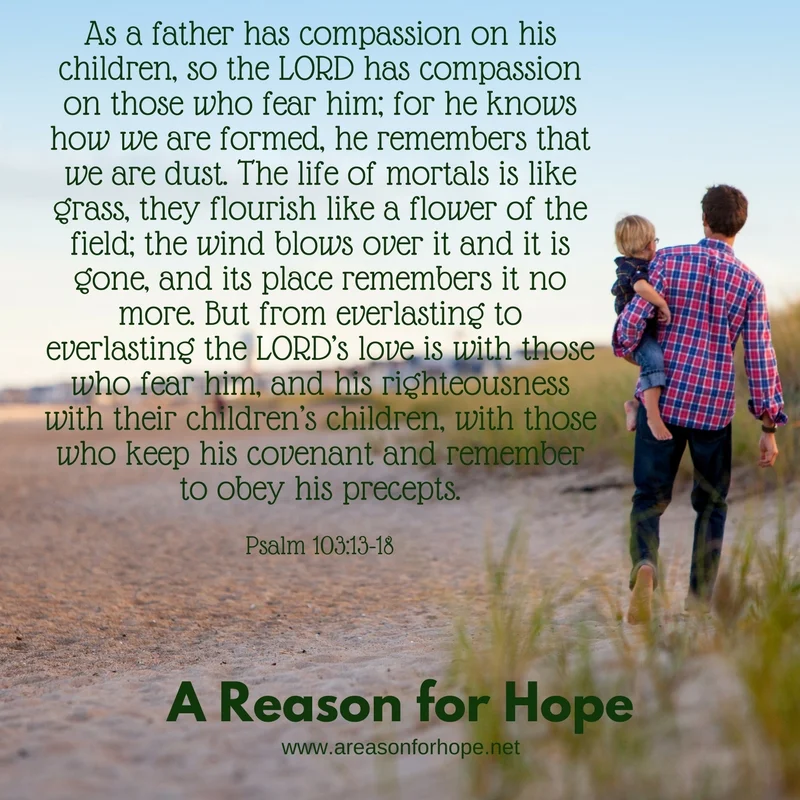
Then comes an amazing comparison of the love of the Father to the love of earthly fathers. Earthly fathers are encouraged to mirror the Heavenly Father’s love, providing spiritual, emotional, and wise guidance. Unfortunately many chlldren grow up without loving fathers: maybe overly harsh, cruel. demanding fathers. Ephesians 6:4 “Do not exasperate your children; instead, bring them up in the training and instruction of the Lord”. Maybe absentee fathers who just weren’t present in their children’s lives much. Maybe fathers who left their wives and split their homes, leaving the children questioning the value of familial love. But a loving earthly father mirrors the heavenly Father’s love. Such a father never quits loving his children no matter what they do. He might disapprove of what they do or even be forced to administer “tough love” in extreme cases, but he will always be ready to forgive and restore even wayward children. The parable of the prodigal son demonstrates that. The father in that parable is God the Father, and he immediately forgave his wayward son who had taken his share of his inheritance and squandered it and was returning home hoping just to be a servant and have food to eat. Instead, the father killed the fatted caff and made a feast. Unfortunately the older brother did not have that love for his younger brother. The older brother represented the Pharisees who were criticizing Jesus for eating with sinners. Charles Dickens and Ralph Waldo Emerson praised that parable as one of the greatest short stories ever told.
BTW a side story: AI: “Martin Luther deeply struggled with viewing God as a loving Father due to his own harsh, authoritarian earthly father, Hans Luther, whose stern discipline mirrored Luther’s view of a wrathful, judgmental God, making the concept of divine grace a massive breakthrough as he realized God’s love was freely given, not earned through works or fear. This personal conflict fueled his spiritual despair, as his intense efforts as a monk only intensified his sense of sin and God’s distance until he discovered justification by faith.” Even if a child did not have a loving earthly father, he can still find one in the loving heavenly Father. It might be more difficult for him, but it should make the love of the heavenly Father even more amazing.
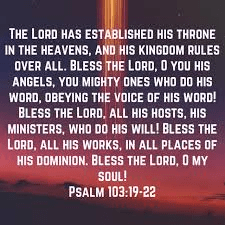
Psalm 103:19-22 ends with a call for the angels and for all of God’s creation to “Bless the Lord”.
This was long but what a great psalm. Perhaps you can see why I consider it one of my favorite, if not most favorite, psalms.
 Nicky's Notes