
1) BY FAITH MOSES WAS HIDDEN FROM PHAROAH WHEN HE WAS BORN. Hebrews 11:23 By faith Moses, when he was born, was hidden for three months by his parents, because they saw he was a beautiful child; and they were not afraid of the king’s edict.” Of course, this was by the faith of his parents and not the faith of the baby Moses. Kinda like when parents have their babies baptized, trusting that the parents and the church will bring that baby up to be a Christian some day. That baby doesn’t even know what is going on, except a few annoyng drops of water. Interesting: the Orthodox Church immerses those babies 3 times! That must be a frightening experience for the baby! Back to Moses as a baby. It took a lot of courage for Moses’ parents to hide the baby Moses for 3 months. There were probably taskmasters roaming in and out of the Israelite houses or tents, listening for a crying baby that they would then kill. Maybe even a fellow Israelite would know about the hidden baby Moses and tell the taskmasters to get a reward of some kind. Non-Jews often sold out the location of Jews in hiding for money from the Germans. Did Moses’ parents just want to protect their little newborn? They hid the baby by faith, so maybe they had faith that God would help them find a way to save their baby. Maybe they even knew that the time was nearing for God’s promise (Genesis 15) to bring Israel out of foreign slavery and they had faith that their baby might be the deliverer chosen by God. It takes a lot of faith to raise a child for the Lord in today’s sinful culture. AI: “Proverbs 22:6, “Train up a child in the way he should go, and when he is old he will not depart from it,” is a biblical mandate for parents to provide godly guidance, education, and nurturing in the early, formative years. This training involves nurturing a child’s spiritual, moral, and emotional development, creating a lasting foundation that influences their character throughout life.” Too often parents are too busy with their careers and their own interests. They allow the world to train up their children. Then they are shocked when their children turn to alcohol, drugs and porn. 66-75% of teens raised in churches leave their churches during or after college. They might not leave their faith in God and Jesus, but many do that also.
2) BY FAITH MOSES CHOSEN TO SUFFER WITH GOD’S PEOPLE INSTEAD OF ENJOYING LIFE IN EGYPT Hebrews 11:24 By faith Moses, when he had grown up, refused to be called the son of Pharaoh’s daughter, 25 choosing rather to endure ill-treatment with the people of God than to enjoy the temporary pleasures of sin, 26 considering the reproach of Christ greater riches than the treasures of Egypt; for he was looking to the reward.” When did Moses make this choice? He was raised by Pharoah’s daughter and had the luxurious life of an Egyptian prince. Who told him that he was a Hebrew and not an Egyptian? When did he figure that out? His mom nursed him for Pharoah’s daughter but did she have any further contact after he was weaned? We do know that at the age of 40 he made the choice to join the Hebrew slaves. Acts 7:20 At this time Moses was born; and he was beautiful to God. He was nurtured for three months in his father’s home. 21 And after he had been put outside, Pharaoh’s daughter took him away and nurtured him as her own son. 22 Moses was educated in all the wisdom of the Egyptians, and he was proficient in speaking and action. 23 But when he was approaching the age of forty, it entered his mind to visit his countrymen, the sons of Israel. 24 And when he saw one of them being treated unjustly, he defended and took vengeance for the oppressed man by fatally striking the Egyptian. 25 And he thought that his brothers understood that God was granting them deliverance through him; but they did not understand.” At 40 he visited the Hebrew slaves, probably to tell them that he was ready to be their deliverer from slavery. He is casting his lot with the slaves, never to be able to go back to being an Egyptian prince. He kills the taskmaster, thinking that will be the sign that he is the deliverer. But the next day Moses broke up a fight between two Hebrew slaves and one of them said “‘Who made you a ruler and judge over us? 28 You do not intend to kill me as you killed the Egyptian yesterday, do you?’” Moses knew then that they were not ready to follow him in a slave Spartacus like rebellion. Perhaps Moses planned for the 600,000 male slaves to take up their tools as weapons and attack the Egyptians. We don’t know what his plans for rebellion were. It is understandable that the slaves rejected Moses. Why would they accept an Egyptian prince in fine clothes to be the deliverer, one who had never been a slave a single day, one who had never shared their miseries of slavery? Let’s give Moses credit for his faith in this incident at the age of 40. He did what he did by faith, believing that God was going to use him to deliver the slaves. Was he just sympathetic to their suffering, or did he somehow find out God’s promise to Abraham in Genesis 15 that after 4 generations the Hebrew slaves would be delivered? We just know that he acted by faith in God’s protection and promises. Why at age 40? Did he only realize he was a Hebrew close to turning 40 or had he known that for a long time before that but just got the courage and decided to act when he turned 40? “According to the Talmud (Avot 5:26), 40 is the age when one moves from knowledge to deeper understanding (binah). Famous sages like Hillel, Johanan ben Zakkai, and Akiva only began their intensive rabbinical careers at age 40, following a similar pattern to Moses.” (AI) Coincidence that Moses made his life changing decision at age 40? What does it mean that he “considered the reproach of Christ greater riches than the treasues of Egypt”? He did not know about the suffering of Christ 1500 years later, but the Hebrew writer sees a parallel of Moses’ choice to suffer with Christ’s suffering. In Moses’ mind God would give him a greater reward by joining God’s suffering people than the luxurious life of a prince. That is faith!
3) BY FAITH MOSES LEFT EGYPT NOT FEARING THE WRATH OF PHAROAH Hebrews 11:27 By faith he left Egypt, not fearing the wrath of the king; for he persevered, as though seeing Him who is unseen.” Is this referring to when Moses left Egypt at the age of 40 when he saw that the slaves were not ready to accept him as their deliverer? If so, it contradicts Exodus 3:14 Then Moses was afraid and said, “Surely the matter has become known!” 15 When Pharaoh heard about this matter, he tried to kill Moses. But Moses fled from the presence of Pharaoh and settled in Midian.” Moses fled from Phaoah and left Egypt, but Hebrews 11:27 says that he left Egypt “not fearing the wrath of the king (Pharoah)”. Most think that Hebrews 11:27 is referring to Moses leaving Egypt at the age of 80, leading the slaves on the exodus from Egyptian slavery. Moses made excuses at the burning bush for not wanting to obey God’s command to go tell Pharoah to let the slaves go free. No doubt his old fears of Pharoah came to his mind at the burning bush. But when he stood before Pharoah telling Pharoah to let the slaves go free, Moses was no longer afraid. God had given Moses miraculous signs to use when he stood in Pharoah’s court (the staff turning. to a snake and his hand becoming leprous and then clean) that would bolster Moses’s confidence and ease his fears. What made Moses so courageous when he stood before Pharoah? AI: “He stood before Pharaoh, backed by divine authority, to demand the release of the Israelites, persevering by focusing on the invisible God rather than the intimidating ruler.” “As though seeing Him who is unseen” (Hebrews 11:27). His faith in the unseen God gave him courage to overcome his fears. What are your fears? Failure in your career? Sickness and cancer? Of death? Your fears can be fear of someone or something. You can overcome your fears by faith, by trusting in God. The thing you fear might still happen, but you will face it courageously in faith. You will find something good even in bad circumstances, or you will find eternal life if you die from what you fear. Isaiah 41:10 So do not fear, for I am with you; do not be dismayed, for I am your God. I will strengthen you and help you; I will uphold you with my righteous right hand. Psalm 27:1 The Lord is my light and my salvation— whom shall I fear? The Lord is the stronghold of my life—of whom shall I be afraid? Psalm 118:6 The Lord is with me; I will not be afraid. What can mere mortals do to me? John 14:27 Peace I leave with you; my peace I give you. I do not give to you as the world gives. Do not let your hearts be troubled and do not be afraid.
4) BY FAITH MOSES AND ISRAEL KEPT THE PASSOVER Hebrews 11:28 By faith he kept the Passover and the sprinkling of the blood, so that the destroyer of the firstborn would not touch them.” This of course refers to the night when the death angel passed through Egypt killing all the firstborn of the Egyptians. The firstborn of the Israelites could be saved by sprinkling blood on their doorposts. The Israelites would eat the Passover lamb and Passover meal that night, fully dressed, packed, and ready to depart from Egypt on sudden notice. No doubt Moses ate the Passover meal, but did he have his firstborn in Egypt at that time and sprinkle blood on a doorpost to spare his firstborn? Exodus 4 suggests that Moses took Zipporah and his 2 children with him back to Egypt. 4:19 Now the Lord said to Moses in Midian, “Go back to Egypt, for all the men who were seeking your life are dead.” 20 So Moses took his wife and his sons and mounted them on a donkey, and returned to the land of Egypt. Moses also took the staff of God in his hand.” But then clearly Exodus 18:1-7 says that Moses’ father in law Jethro brought Zipporah and the 2 sons to meet Moses when Moses camped at Mt Sinai after crossing the Red Sea. Moses had for some reason sent his wife and sons back to Midian even though they started with him going back to Egypt. 18:2 And Jethro, Moses’ father-in-law, took in Moses’ wife Zipporah, after he had sent her away, 3 and her two sons.” So they did not go to Egypt with Moses. Perhaps he sent them back after the incident where God tried to kill Moses b/c he had not circumcised his son but Zipporah cut off the foreskin and threw it at Moses’ feet and rebuked him ““You are indeed a groom of blood to me!” So Moses would have eaten the Passover lamb meal and maybe even sprinkled blood on the doorpost along with the people even though his firstborn was not in any danger of being killed that night b/c he was in Midian, not Egypt. No doubt the Israelites were in a state of panic as they heard reports of all the firstborn of the Egyptians being killed. Exodus 12:29 Now it came about at midnight that the Lord struck all the firstborn in the land of Egypt, from the firstborn of Pharaoh who sat on his throne to the firstborn of the captive who was in the dungeon, and all the firstborn of cattle. 30 And Pharaoh got up in the night, he and all his servants and all the Egyptians, and there was a great cry in Egypt, for there was no home where there was not someone dead.” The generation of those slaves who left Egypt never made it to the promised land b/c of a lack of faith (Hebrews 3), but they at least had enoug faith to put that blood on their doorposts. Moses had faith to keep that Passover that night also. The Passover feast was to be an annual feast of the Jews although they did not always observe it properly. Most think that they did not observe the Passover in the 40 years in the wilderness (except once at Mt Sinai) b/c they did not circumcise their males as they should, have during that 40 years which was a requirement for keeping the Passover. Joshua corrected that with a mass circumcision ceremony at Gilgal in Joshua 5, after which they kept the Passover. Faithful Jews have always kept the Passover “by faith”. AI: “Jews express profound faith when observing Passover (Pesach) by re-enacting the Exodus story, treating it as a personal liberation rather than just a historical event. The Seder ritual serves as a profound expression of faith in God’s redemption, providence, and the enduring strength of the Jewish people.” We non-Jew Christians are not required to keep the Passover (or any of the Jewish feasts) but it is good when we eat meals with our families and talk about what God has done for us in history by sending Jesus to die for us and making that a very personal thing.
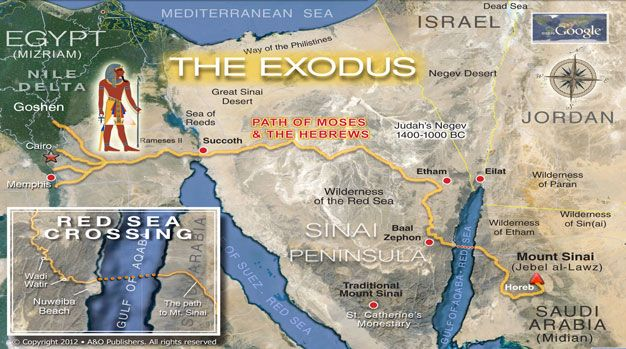
5) BY FAITH MOSES AND ISRAEL PASSED THROUGH THE RED SEA WHEN THE WATERS PARTED. Hebrews 11:29 By faith they passed through the Red Sea as through dry land; and the Egyptians, when they attempted it, were drowned.” Actually the Israelites were in a state of panic when they reached the Red Sea with no visible way to escape the approaching Egyptian army with all their chariots stirring up quite a trail of dust that could no doubt be seen miles away. Exodus 14:10 As Pharaoh approached, the sons of Israel looked, and behold, the Egyptians were coming after them, and they became very frightened; so the sons of Israel cried out to the Lord. 11 Then they said to Moses, “Is it because there were no graves in Egypt that you have taken us away to die in the wilderness? Why have you dealt with us in this way, [bq]bringing us out of Egypt? 12 Is this not the word that we spoke to you in Egypt, saying, ‘Leave us alone so that we may serve the Egyptians’? For it would have been better for us to serve the Egyptians than to die in the wilderness!” Not much faith there! God had purposely brought them to this crisis of faith but they were failing. Moses told them, ““Do not fear! Stand by and see the salvation of the Lord, which He will perform for you today; for the Egyptians whom you have seen today, you will never see them again, ever. 14 The Lord will fight for you, while you keep silent.” He then parted the sea with his staff so that Israel could cross over. To Israel’s credit, they at least had enough faith to cross through this sea with “the waters were like a wall to them on their right and on their left.” Liberal critics of this story say the waters they passed through were a shallow “sea of reeds” and that a strong wind blew the waters back, which makes no sense at all. There was a “wall” of water on their right and left. They were terrified and it took faith to step into that dry land and walk an estimated 6-10 miles across the Gulf of Aqaba across to the Saudi Arabian coast. I do believe that Mt Sinai was in Midian in modern day Saudi Arabia and not at the traditional site in the Sinai peninsula. Research that if you wish. But can you imagine walking 6-10 miles with loaded carts and animals and children, the whole time these two walls of water ready to crash in on you? Probably glancing back often to see if the Egyptians were crossing also. As you know, after they safely crossed over, God removed the cloud that had been holding the Egyptians back and they tried to cross over on the dry land. Moses stretched out his staff and the waters collapsed on them, killing them all. Exodus 14:30 So the Lord saved Israel that day from the hand of the Egyptians, and Israel saw the Egyptians dead on the seashore. 31 When Israel saw the great power which the Lord had used against the Egyptians, the people feared the Lord, and they believed in the Lord and in His servant Moses.” Truly, Hebrews 11:29 by faith Israel crossed the Red Sea. That incident would be the high point of their faith. After the crossing, they would camp at Mt Sinai for a whole year. They would worship the golden calf while Moses was on Mt Sinai getting the 10 commandments. They would complain about lack of water and food, never trusting God for their needs. Moses would send out the 12 spies and the people would rebel, wanting to return to Egypt instead of trusting in God to defeat the Canaanites as Joshua and Caleb did. Hebrews 3 says that they were not allowed to enter the promised land b/c of a lack of faith. Hebrews 3:16 For who provoked Him (God) when they had heard? Indeed, did not all those who came out of Egypt led by Moses? 17 And with whom was He angry for forty years? Was it not with those who sinned, whose dead bodies fell in the wilderness? 18 And to whom did He swear that they would not enter His rest, but to those who were disobedient? 19 And so we see that they were not able to enter because of unbelief.” It is interesting that the Hebrew writer commends the faith of Israel in crossing the Red Sea since that was their only moment of faith ever and they would then later become perhaps the worst example of faith. Did you have great faith at one time but now it seems as if your faith is weak? If so, then you need to go back to the great works of God that he has done. The miracles of the Old Testament, the miracles of Jesus.
 Nicky's Notes