
I like outlines of books. Seldom does a book of the Bible actually give an outline for that specific book, but Genesis does.
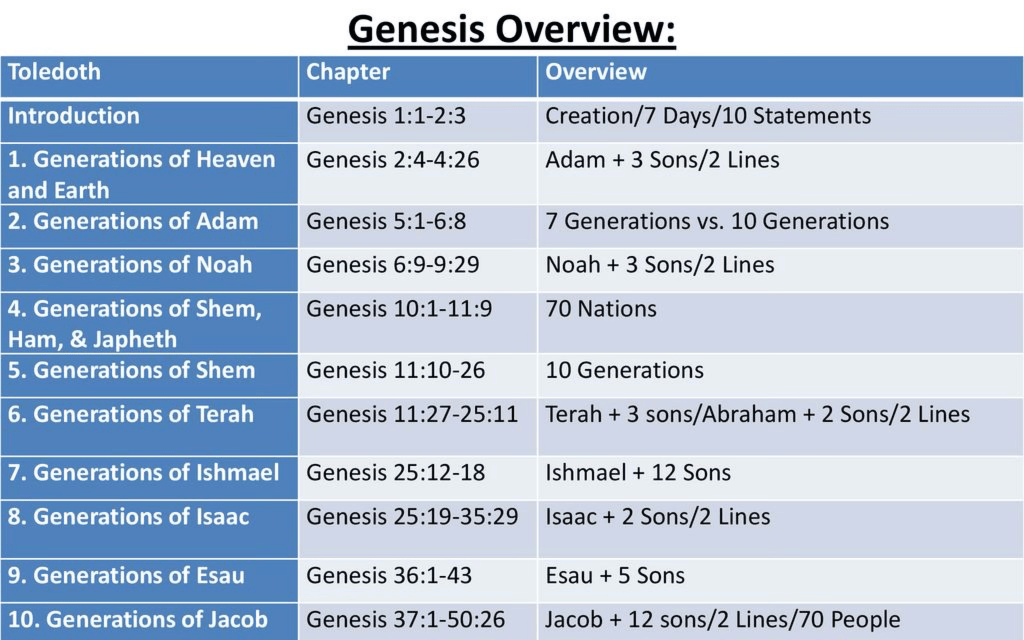
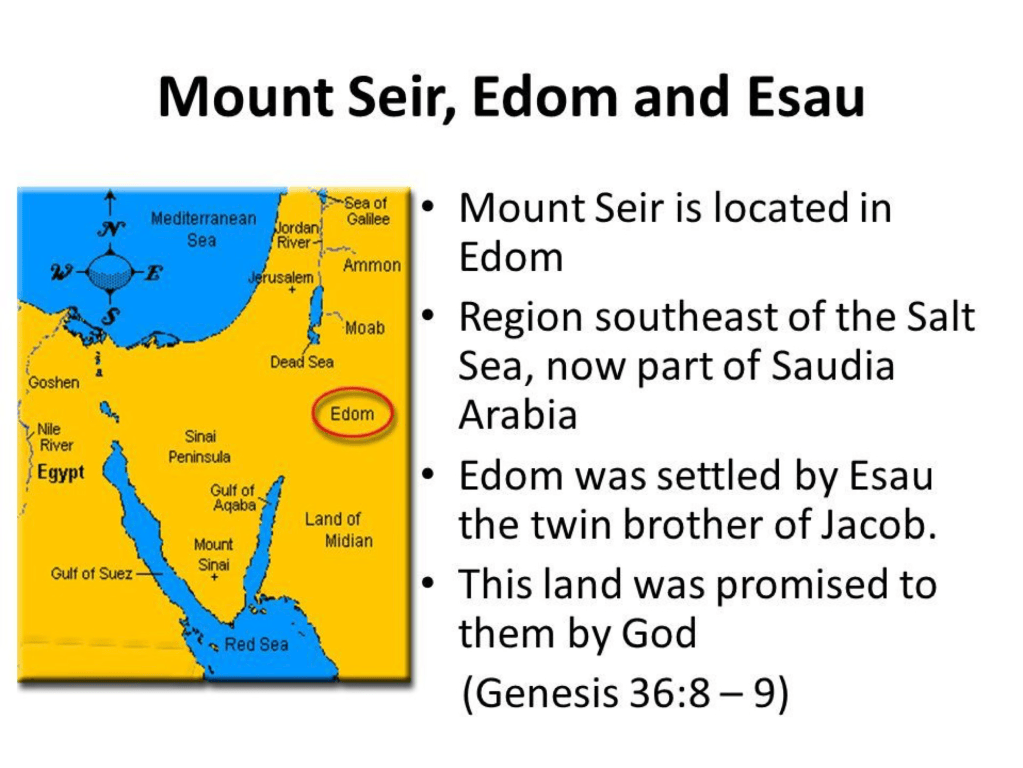
Each part of the outline begins “These are the records of the generations of …” as in Genesis 36:9 “These are the records of the generations of Esau” and then 37:1 “These are the records of the generations of Jacob”. It is interesting that Abraham, a main character in Genesis, does not have his own “generations of Abraham”. Instead, he is included in the “generations of Terah” (his father). Likewise, Joseph has 13 chapters (Genesis 3-50) devoted to his life, but does not have have his own “generations of Joseph”. Instead he is included in “the generations of Jacob” (his father). But Ishmael, Abraham’s son by Hagar, has his own “These are the records of the generations of Ishmael” in Genesis 25:12 which would not seem important to the Jews since Isaac, born to Sarah, was the son of the promises to Abraham and not Ishmael. But both Ishmael and Esau had many powerful and important descendants. Esau has his own chapter of generations (chapter 36).The Arabs come from Ishmael. The Edomites descended from Esau. The Edomites played a complex role in the history of Israel. They refused to allow Israel to pass through their territory as Israel was making their way to Canaan. The Edomites cheered and plundered Jerusalem when Babylon destroyed Jerusalem in 586 BC. The short one chapter book of the prophet Obadiah is a prediction about the destruction of Edom b/c of “violence done to your brother Jacob”, b/c they took part in plundering and “looting” Jerusalem when it fell, b/c they “gloated and rejoiced” over the fall of Jerusalem, b/c they killed or imprisoned fugitives trying to escape from the city when it fell. Obadiah mentions their arrogance: they live in mountain ranges like Petra where they felt no enemy could defeat them. AI: “the ancient city of Petra in Jordan appears in Indiana Jones and the Last Crusade (1989). Harrison Ford and Sean Connery’s characters travel through the narrow gorge (the Siq) and arrive at the Treasury where the holy grail is during the final sequence of the film.” The Edomites grew rich and proud from controlling trade routes that passed through Edom. But Obadiah predicted the destruction of Edom and the house of Esau. That prophecy was fulfilled by the time of the Romans when Edom no longer existed as a separate people. The only survivors were living in Idumea, not Edom, and were called Idumeans. Herod the Great who ruled Judea was an Idumean appointed by the Romans as king. More than you wanted to know about Edom, maybe, but Genesis 36 and the book of Obadiah show the importance of Edom and the descendants of Esau in the Bible.
Moving on to Genesis 37:2 “these are the records of the generations of Jacob”. The life of Jacob was already told in Genesis 25-36, so this last section of generations in the Genesis outline is really mainly about Joseph and the other sons of Jacob, along with Jacob, moving to Egypt during the famine. Jacob committed favoritism, just as his parents Isaac and Rebekah had done with him and his brother Esau, by loving Joseph more than his other sons. Joseph was the son of his favorite wife Rachel. It caused his brothers to hate him and sell him to a caravan going to Egypt. Joseph even contributed to their hatred by telling them of his dreams of the brothers, even including Jacob and Rachel, bowing down to Joseph. Why tell that dream to your brothers who already hate you and are jealous of you? Did Joseph have a little bit of an “attitude”, “better than his brothers”? Joesph was given special privileges. The brothers were out shepherding the flocks, but not Joseph. He was back with Jacob who sent him to check up on his brothers who have moved the sheep to Dothan, about 65 miles north of where they all lived in Hebron. So shepherding and finding pasture for large flocks all over Canaan would have been hard work that Joseph (and probably Benjamin, Jacob’s other favorite son by his wife Rachel) were exempt from that hard work. Jacob made Joseph a “coat of many colors” which made his brothers hate him even more. Stop and youtube Dolly Parton’s song, “Coat of many colors”. Her mother sowed her a coat from rags, inspired by the Bible story of Joseph’s coat of many colors. So when he found his brothers, they put him in a pit and eventually sold him to the caravan going to Egypt. They dipped his coat in animal blood and showed it to Jacob, saying an animal had killed Joseph. Jacob was very grieved. He would believe that Joseph was dead for the next 22 years before he was reunited with Joseph in Egypt. Life Lesson: Be thankful if you have never been involved in some type of family conflict among siblings or parents! Many of us have and it is a miserable thing to deal with. Joseph and his brothers will end up in a happy reunion 22 years later, but many sibling and family conflicts don’t end up in happy reunions. They end up with hatred and bitterness, accusing each other of wrong doing, squabbling over family inheritance, one sibling having to care for aging parents while the other siblings just give lip service. If you do have such family conflicts, try to be the peacemaker. You may end up being the responsible sibling who does more work and sacrifices more than the others, but God will reward you for your integrity and your sense of responsibility.
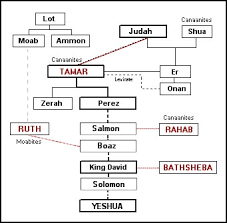
Then we come to one of the strangest chapters in the Bible, Genesis 38. Right in the middle of telling about Joseph’s childhood and being sold into slavery in Genesis 37 and his being a slave to Potiphar in Egypt in Genesis 39 is a totally unrelated chapter about a sordid affair in Genesis 38. Read it for the details. Judah, Jacob’s son who is in the seed line of the rightful kings of Judah down to Jesus, unknowingly goes to a prostitute who is his daughter in law Tamar. Tamar married one of Judah’s sons but that son died without a child, so the other two brothers were supposed to take her as wife and bear a child for their deceased brother. This was called the Levirate marriage law and is found in Deuteronomy 25:5-10. The 2nd son refused to put his seed in Tamar and was killed. The 3rd son was still too young, so Judah promised that later he would give that 3rd son to Tamar to bear a child for the deceased brother, but as the 3rd son grew older, Judah failed to keep his promise and failed to obey the Levirate marriage law. He probably knew that his 3rd son was evil like the first two sons and was afraid the 3rd son would disobey and be killed also. Did Tamar know that Judah was prone to visit prostitutes? She dressed up as a temple prostitute and Judah had sex with her, promising to pay her with a goat. He gave her his ring as collateral. But Judah’s friend was sent to give her the goat and recover Judah’s ring but the prostitute (Tamar) was nowhere to be found. Judah discontinues the search for Tamar and his ring, and hopes no one will find out about the sordid affair, making him a “laughingstock”. 3 months later they bring Tamar to Judah b/c she is pregnant, saying she had committed prostitution. Judah said, “Let her be burned”. Burning someone was a capital punishment used for certain crimes in the Old Testament, like a man marrying both a woman and her mother (Leviticus 20:14) or like the burning of Achan for taking forbidden items from Jericho (Joshua 7). Perhaps the victim was killed first and then his/her body burned. As they were carrying her out to be burned, she basically says, “BTW Here is the ring of the man who got me pregnant if you want to track him down and punish him also”. Can you imagine the startled look on Judah’s face as he looks at his own ring that he had given Tamar after having sex with her? The guilt, the shame, the embarrassment, the exposure of his self righteous conviction of Tamar. Can you imagine the startled look on the faces of those who were carrying Tamar out when they realized Judah had gotten his own daughter in law pregnant while she was posing as a temple prostitute? Can you imagine the shock of Judah’s friend, the Adullamite, whom Jacob sent to take Tamar the goat and retrieve his ring? I guess that friend knew Judah had been to a prostitute, which was a sin, but did not know that the woman posing as a prostitute was Tamar. Tamar was not burned, but instead had twins, Perez and Zerah. But the most unusual thing about this sordid affair is that Perez is in the seed line of Jesus. Perez will be the great grandfather of King David! Life Lesson: Don’t judge people based on their family history. I wonder if anyone mocked Perez as he was growing up, knowing that he was the illegitimate “bastard” son of the noble Judah and his daughter in law Tamar. Leviticus 18:15 states directly: “Do not have sexual relations with your daughter-in-law; she is your son’s wife, so you must not have sexual relations with her”. Leviticus 20:12 reinforces this rule, stating that if a man has sexual relations with his daughter-in-law, both of them must be put to death because it is a perversion.” The Law of Moses had not yet been given at the time of Judah, but this would still have been a terrible sin. But this wasn’t the fault of Perez. Often you see children of bad, immoral people. The children might have a rough upbringing with sinful, irresponsible parents. They might end up considered to be “bad” kids and looked down on by outsiders. But you never know what all those “bad” children have gone through. Don’t judge the kids by their family history. We would like to think that Perez handled people knowing about his shameful birth well. Maybe that is why he was chosen to be in the seed line of Jesus instead of Zerah. It had looked like Zerah was coming out of Tamar’s womb first (the midwife put a scarlet thread on Zerah’s hand as his hand first emerged but then his hand drew back and Perez came out first, making him the firstborn). Maybe God knew Perez could handle his family’s sordid history better than Zerah? Surely you have seen that where two siblings from bad parenting and shameful births react totally different to their bad family history. One learns from it and uses it to be a better person than his/her parents. The other lets the family history make him a victim of self pity all his life.
Genesis 39 and 40 tell about Joseph being a slave to Potiphar in Egypt and being imprisoned falsely b/c Potiphar’s wife falsely accused him of trying to rape her when it was really she who was trying to seduce Joseph. The thing we admire about Joseph is his integrity and character. He could have just become another miserable slave, wallowing in self pity. Instead he was such a loyal and responsible slave to Potiphar that he was put in charge of everything Potiphar had. He had moral integrity. They say, “integrity is doing what is right when no one is looking”. Surely it was tempting for Joseph to have sex with Potiphar’ wife. He perhaps had never had sex with a woman. He wouldn’t want to risk causing her to become angry with him by rejecting her advances, would he? Surely they could keep it a secret affair and Potiphar never find out? But Joseph “just said no”. He apparently had his convictions on not having sex out side of marriage. He told her, “No, I won’t sin against my master and against my God”. “Hell hath no fury like a woman scorned” did not come from Shakespeare. The phrase comes from the English playwright William Congreve in his 1697 play The Mourning Bride. But wherever it originated, it fits Joseph’s predicament. She lies to Potiphar and has Joseph thrown in prison unjustly. Life Lesson: Stats say that 25% of marriages have some adulterous affair. AI: “When emotional affairs, online connections, and sexting are included, rates jump to roughly 45% for men and 35% for women. Many couples report that emotional cheating can hurt a relationship just as much as a physical affair.” Paul said that fornicators and adulterers will not inherit the kingdom of God (1 Corinthians 6:9,10). He then added, “6:18 Flee immorality. Every other sin that a man commits is outside the body, but the immoral man sins against his own body. 19 Or do you not know that your body is a temple of the Holy Spirit who is in you, whom you have from God, and that you are not your own? 20 For you have been bought with a price: therefore glorify God in your body.” Joseph literally “fled” from Potiphar’s wife, leaving his garment in her hand. To resist fornication (sex outside of marriage) or adultery (sex with a marriage involved) requires that a person has conviction about his sexual boundaries, about how far he/she will go sexually in a relationship. He/she already has his/her mind made up and is ready to say “no” when temptation arises or when he/she is being pressured into having sex. He/she is ready to “flee”. Some good advice: Avoid places or times with close contact where you will be tempted. Promptly just leave a place when you see where it is headed sexually. Don’t give in to lines like “if you loved me then you would have sex with me”. Avoid flirtatious friendships at work that can lead to emotional infidelity. Certainly avoid pornographic literature or videos that can pollute your mind. If you are still young and dating, do group dating so that you won’t find yourself in isolated, tempting or pressured situations. Think about the horrible conseqences to your family if you cheated on your mate. Would an affair be worth the damage it would cause? Get in the word and study passaages about sexual purity.
But again instead of wallowing in self pity in prison, it says that Joseph was such a responsible prisoner that the chief jailor put him in charge of all the other prisoners. Many times people in prison just want to talk about how unfairly they were treated or that they were innocent of charges. They talk about the inequity of their harsh, lengthy prison sentences as opposed to prison sentence given to the rich. They talk about racism being part of prison sentences. Not Joseph. His character is seen as he just sets about to be the best prisoner he can be. Several times it says “The Lord was with Joseph and prospered Joseph”, both in Potiphar’s house and in prison, showing how God rewards integrity and character. Life Lesson: I have a friend who spent 25 years in prison for committing murder. He never once said he was innocent or that he got an unfair prison sentence (he got “life” but not “life without parole”). He had no money so that didn’t help in his legal representation, but he never complained. I would talk to him once a month for 25 years. I baptized him while he was in local jail waiting on his trial. We studied the Bible once a week. We studied a lot of Old Testament history just like the past few weeks of our study. In prison, he spent his time studying the Bible and trying to convert other prisoners. He had his depressed times, but usually we talked about people he was trying to help. Finally after 25 years and 2 or 3 “parole denied” hearings, he was released on parole and is still on parole. But the Lord rewarded him for his integrity and character. He has held a steady job and gone to church regularly since his release. His faith is still strong and he helps others. Not all prisoners released do as well as my friend. The stats say 70% of prisoners released end up back in prison within 5 to 9 years after release. Prison ministry is a difficult one with many failures. But that doesn’t mean that there is not someone who is like my friend, who is part of the 30 % who do not end up back in prison. If released prisoners have the integrity and character of Joseph, they can live successful lives in spite of their past history and crimes. Don’t judge someone when you find out they have been in prison before. It might just be like my friend.
Finally, chapter 40 tells about Joseph interpreting the dreams of two fellow prisoners that leads to the release and restoration to his job of Pharoah’s butler and the beheading of Pharoah’s baker. The sad part about this is that Joseph asked the butler to remember him after he will be released. The butler was restored to his position and could have helped Joseph get out of prison a lot earlier than the did but the butler forgot Joesph and what Joseph had done for him. Life Lesson: Have you ever helped someone and just asked them to remember you in the future if you need their help- but they forgot you? Someone said, “I’m tired of people just remembering me when they need help”. They never call me or socialize with me, but then out of the blue they call me wanting help in some way. They never call you or contact you unless they need something. Do you ever feel like people are “using you” to get what they want? They don’t really appreciate your friendship or what you have done for them. They seldom thank you or show appreciation. That’s ok. Find new friends who are loyal to you. Two great verses to close with: Proverbs 18:24: This verse warns against fake companions and highlights that a real friend sticks closer than a brother. Proverbs 17:17: This verse explains that a true friend loves at all times and is born to help during times of distress.
This has been long but there is so much to discuss in Genesis, especially doing 5 chapters at a time. I hope you are keeping up with the daily reading. Sept 3 will be Genesis 41-45 and Joseph’s time in Egypt.
 Nicky's Notes