
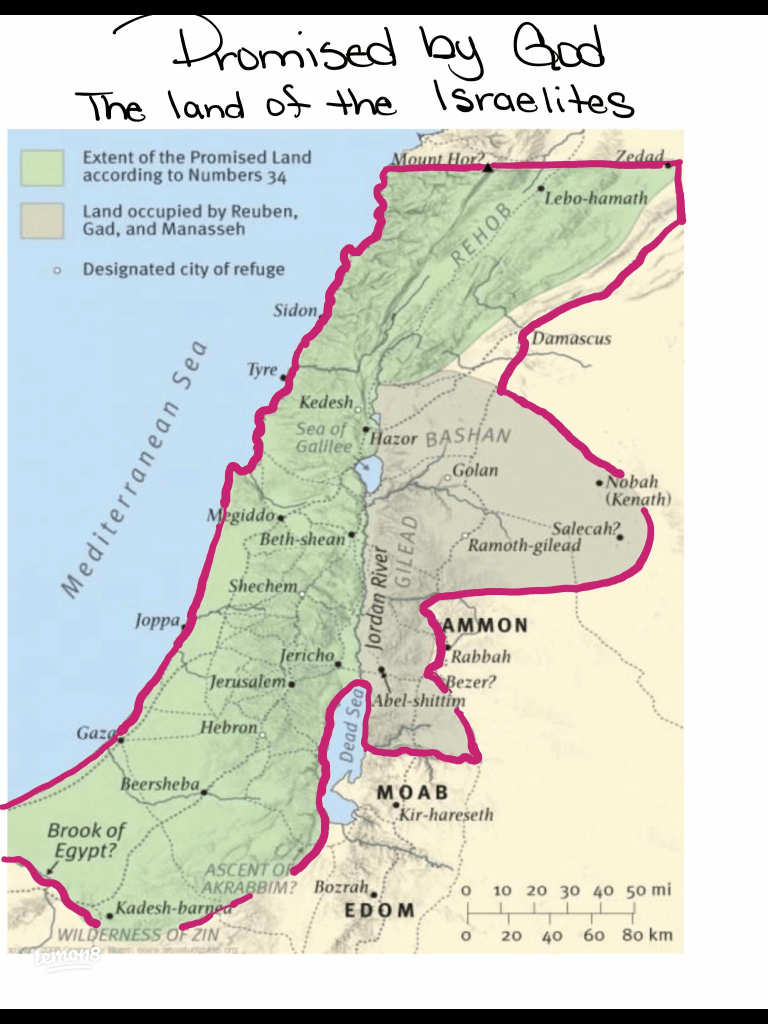
Numbers 34: The borders of the Promised Land. Here is a good map that shows the borders of the promised land. We assume that Moses wrote this after the 40 years in the wilderness as Israel was on the last leg to going into the promised land.
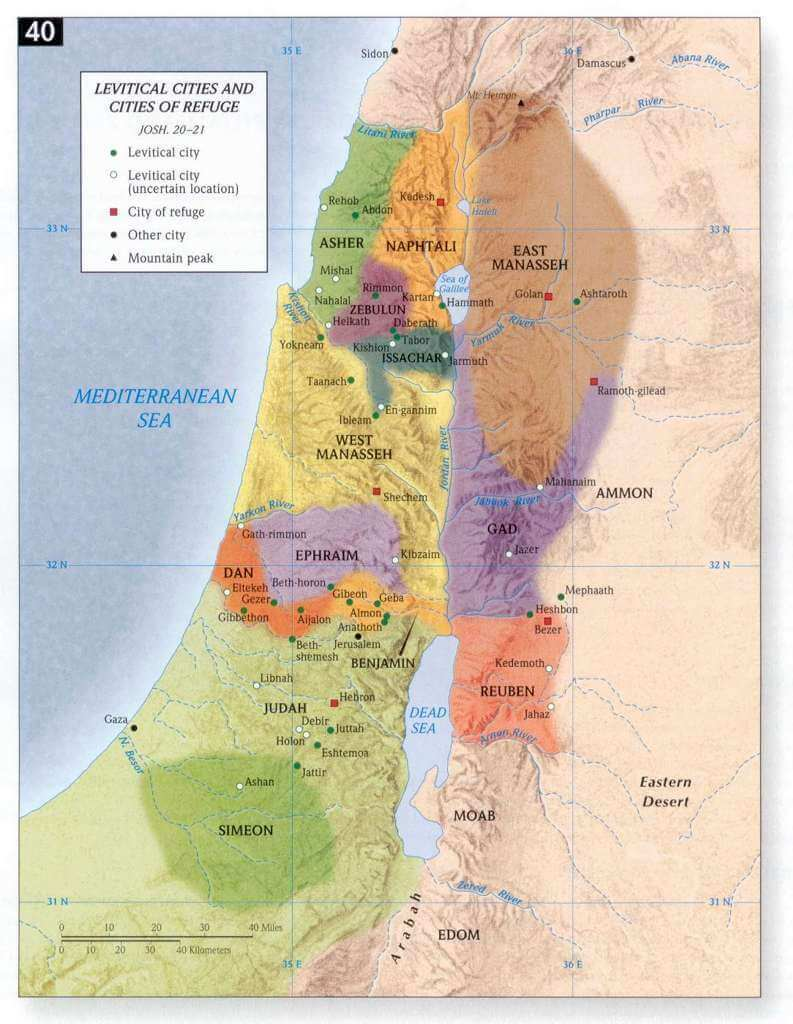
Numbers 35: The 48 Levitical cities and 6 cities of refuge. The Levitical cities also had rights to use the pasture land around the cities. The Levites were the teachers of the Law for all the tribes. The cities of refuge were for anyone who killed someone but not premeditated, what we would call “manslaughter” not capital murder. Such a person could find safety from the “blood avenger” of the relative he/she killed as long as they stayed in the city until the current high priest died. Again, maps.
Numbers 36: Laws of inheritance. Do you remember those daughters of Zelophehad (Numbers 27)? AI: “The daughters of Zelophehad were five courageous sisters—Mahlah, Noah, Hoglah, Milcah, and Tirzah—who successfully petitioned Moses for the right to inherit land in the Promised Land when their father died without sons. Later, the leaders of Manasseh raised a concern that if the daughters married men from another Israelite tribe, their inherited land would transfer away from Manasseh. In response, God added a stipulation: the daughters were permitted to marry, but only within their own paternal tribal clan. The sisters complied and married their uncles’ sons (their cousins), securing both their inheritance and tribal integrity.” In other words, the land given to each individual tribe would belong to that tribe forever. No tribe could possess the land of another tribe.
DEUTERONOMY
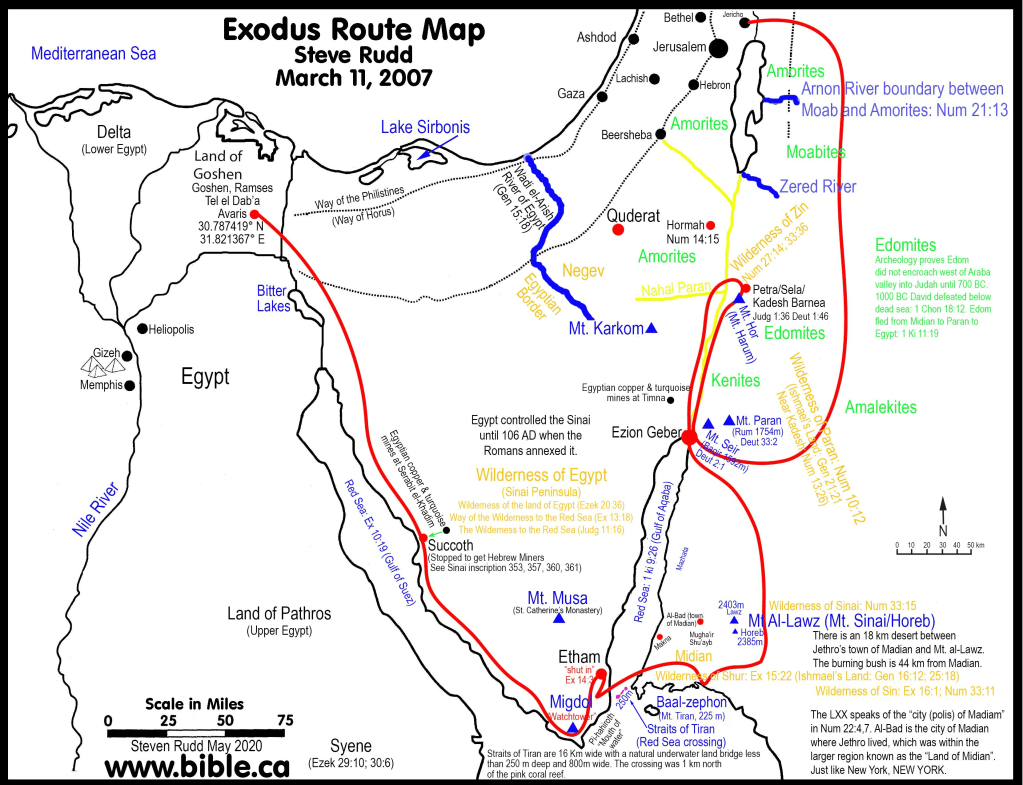
Deuteronomy begins with Israel camped on the plains of Moab east of the Jordan River, just across the Jordan from Jericho, the first city that Israel would conquer under Joshua. They stayed in the plains of Moab several months. Deuteronomy 1:3 notes that Moses began delivering his final speeches on the first day of the eleventh month of the 40th year. So, one year at Sinai, 38 years wandering in the wilderness, one year on the final leg of their journey to Canaan.
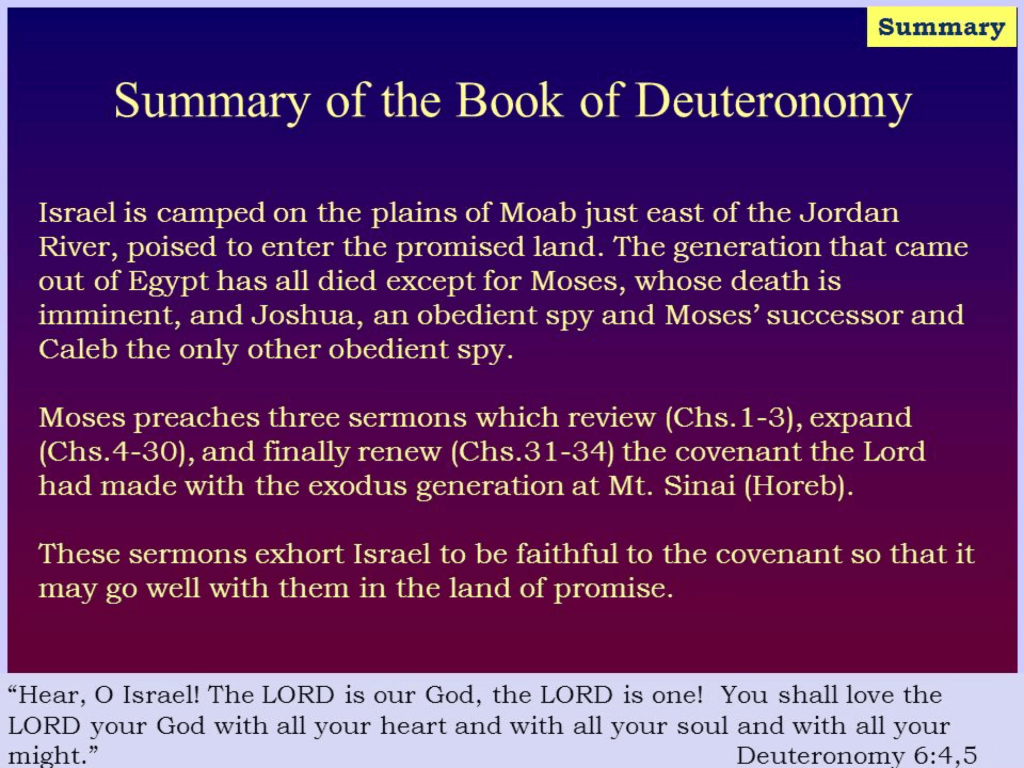
Here is a great slide that summarizes Deuteronomy. The book is basically 3 sermons of Moses before he dies.
Deuteronomy 1: Moses reviews the history of Israel up to the time they arrived in the plains of Moab.
Deuteronomy 2: More history including mention of the 38 years of wandering in the wilderness and how God had told Moses not to kill any of the Edomites, Moabites, or Ammonites b/c they were related to Israel. Edomites came from Esau, Jacob’s brother. Moabites and Ammonites came from the incestuous relationshp Lot’s 2 daughters had with him while he was drunk after the destruction of Sodom.
I think you will find this book very interesting. It contains a lot of laws that were only for Israel, but it also contains a lot of God’s laws that apply to His children for all ages.

