
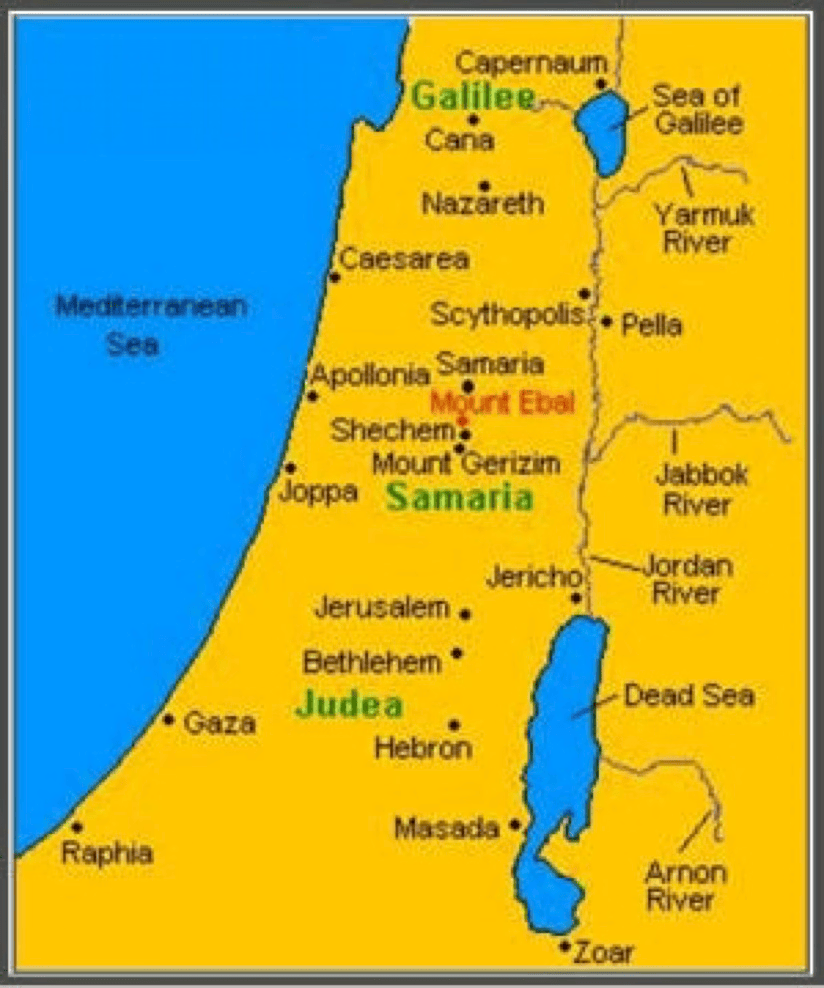
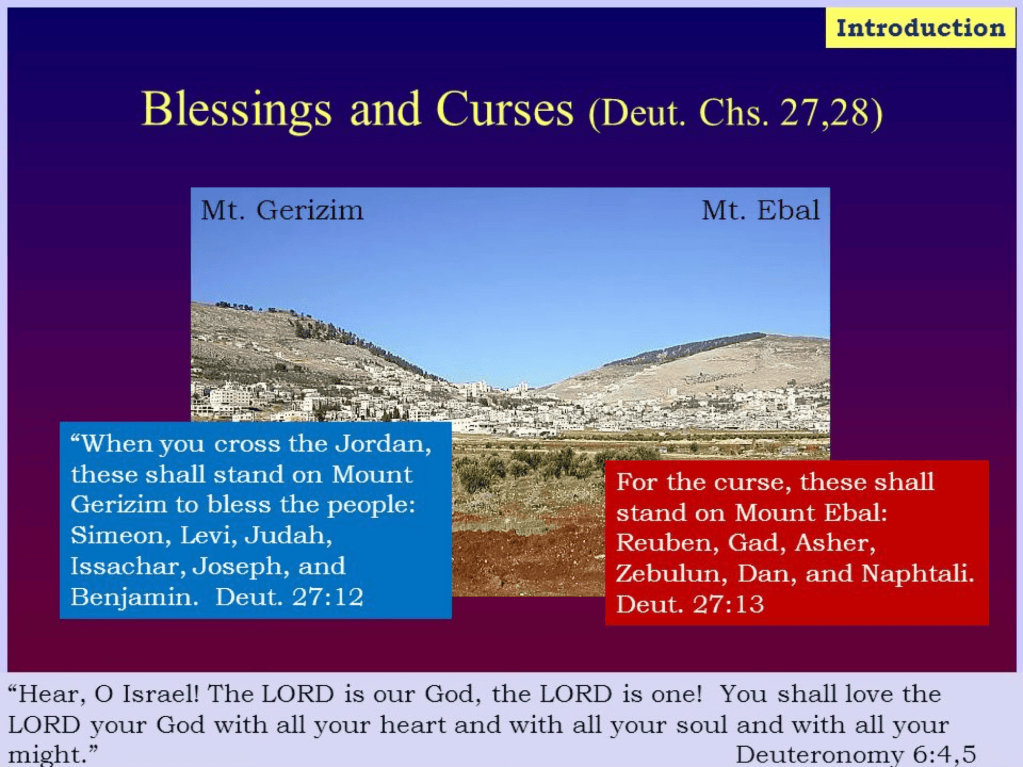
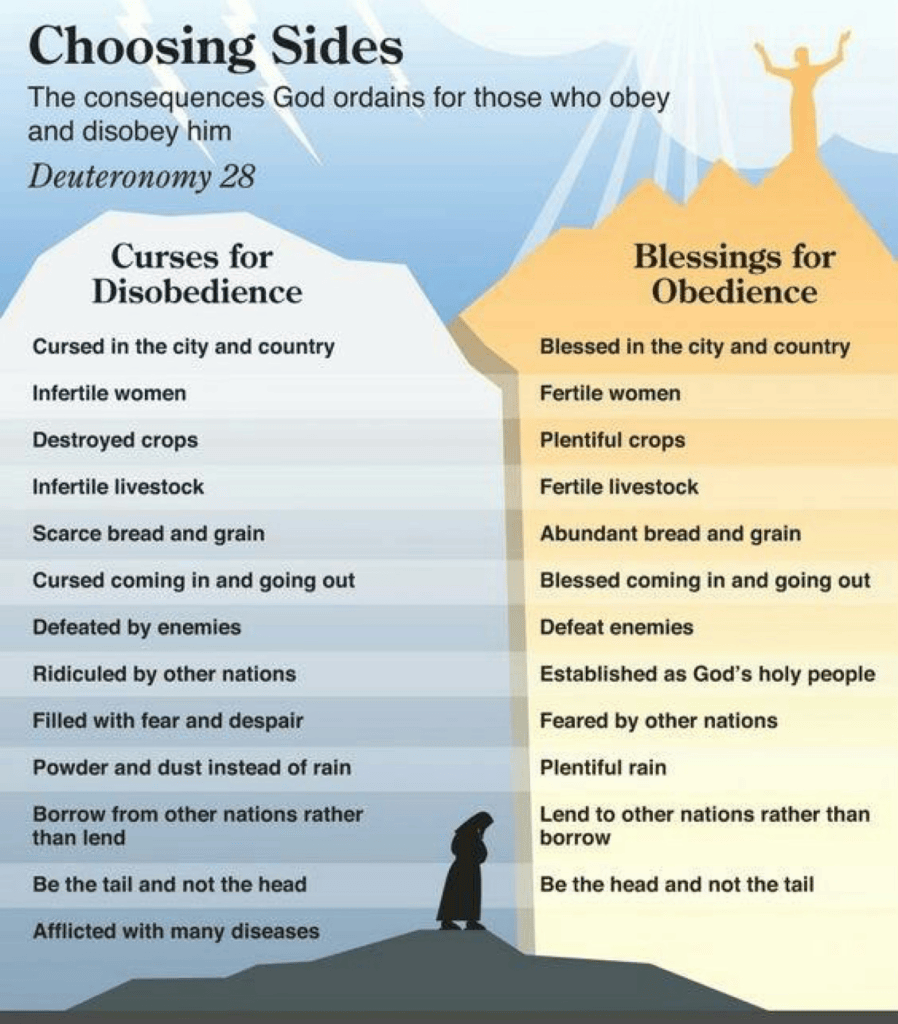
Deuteronomy 28: The list of blessings for obeying God that was to be read on Mt Gerizim and the curses for not obeying God that was to be read on Mt Ebal when they entered Canaan. Deuteronomy 27 gave the reading of the curses for disobeying God to be read from Mt Ebal, and Deuteronomy 28 gives more curses to be read. Half the tribes gathered on Mt Ebal and half on Mt Gerizim. The priests and Levites stood between the mountains with the Ark of the Covenant to read the laws, blessings, and curses.Mount Gerizim was historically lush and green, symbolizing life and the rewards of obedience. Mount Ebal was rocky and barren, symbolizing the severe consequences and desolation of turning away from the commandments. Notice how all the blessings and curses were physical in nature. That is the way it was in the old covenant. The new covenant is not like that. In the new covenant believers in Jesus are promised primarily spiritual blessings (the forgiveness of sins, eternal life, spiritual peace, etc.) When you read the Old Testament you have to remember that. If you read the New Testament thinking that we are promised the same physical blessings as in the Old Testament then you will be disappointed in Christianity. Many Christians have died violently at the hands of their enemies in the history of the church.

Deuteronomy 29: While camped on the plains of Moab, Moses renews the same covenant as made at Mt Sinai 40 years earlier. He gives a warning that the nation will scattered if they disobey God.
Deuteronomy 30: God promised to restore the nation back to the Promised Land if they are ever scattered due to disobedience and if they repent. An interesting conclusion after giving all these laws. Someone might say that the requirements of keeping the Law was not possible so why try. 30:11 “For this commandment which I command you today is not too difficult for you, nor is it out of reach. 12 It is not in heaven, that you should say, ‘Who will go up to heaven for us to get it for us and make us hear it, that we may observe it?’ 13 Nor is it beyond the sea, that you should say, ‘Who will cross the sea for us to get it for us and make us hear it, that we may observe it?’ 14 But the word is very near you, in your mouth and in your heart, that you may observe it.” In other words, keeping the Law is “doable” Sure, they would sin but there were sacrifices for the forgiveness of sins that would keep them in good standing with the Law. Someone could actually be called “blameless”, as Paul described himself in Philippians 3:6. Psalm 119:1: “Blessed are those whose ways are blameless, who walk according to the law of the Lord.” Under the new covenant that righteousness by Law keeping could not save someone eternally. Righteousness that comes through faith in Jesus is required for salvation. Paul in Romans 10 contrasts the righteousness that came from the Law with the righteousness that comes through faith in Jesus. The righteousness that come through faith in Jesus is also “doable”. He quotes Deuteronomy 30:11-14 and applies that to the righteousness that comes by faith which is given to believers through simple faith and not strict obedience to even new covenant laws. Romans 10: 5 For Moses writes that the man who practices the righteousness which is based on law shall live [c]by that righteousness. 6 But the righteousness based on faith speaks as follows: “Do not say in your heart, ‘Who will ascend into heaven?’ (that is, to bring Christ down), 7 or ‘Who will descend into the abyss?’ (that is, to bring Christ up from the dead).” 8 But what does it say? “The word is near you, in your mouth and in your heart”—that is, the word of faith which we are preaching, 9 that if you confess with your mouth Jesus as Lord, and believe in your heart that God raised Him from the dead, you will be saved; 10 for with the heart a person believes, resulting in righteousness, and with the mouth he confesses, resulting in salvation. ” Salvation is really simple faith in Jesus. It is not something you have to go up into heaven or down into the abyss to find. It is all right there is the simply proclamation of the gospel. There are new covenant commands that we must obey to be saved, but obedience to those commands is not the basis of our salvation, which is grace through faith in Jesus. We get what Paul called “imputed righteousness” (the righteousness of Jesus put in our spiritual account).
Then follows a great principle of God: 30:15 “See, I have set before you today life and prosperity, and death and adversity; 19 I call heaven and earth to witness against you today, that I have set before you life and death, the blessing and the curse. So choose life in order that you may live, you and your descendants, 20 by loving the Lord your God, by obeying His voice, and by holding fast to Him.” God has given all men freedom of choice in matters of belief and obedience to God. He doesn’t always allow you to choose your circumstances but He always allows you to choose how to respond to your circumstances. God could have made us as programmed robots that are programmed to believe and love him without giving us freedom of choice, but He didn’t. He wanted our love to be voluntary. BTW Calvinism’s doctrine of unconditional predestination of the elect and those to be sentenced to hell does not allow that freedom of choice. Under Calvinism those predestined to hell cannot simply choose to believe and be saved b/c they are “totally depraved”. That is a doctrine that would make us question the love of God. If I could just arbitrarily choose which of my 3 children were going to be saved and which were going to be lost, why wouldn’t I choose all 3 to be saved? Why would I choose any of the 3 to be lost if it was totally up to me and not them? Calvinism would make God like a parent who arbitrarily chooses some of his children to be lost, not giving them a choice.
Deuteronomy 31: Moses gives his last words of warning. He charges his replacement, Joshua, to be “strong and courageous”. God even told Moses that Israel would worship other gods and fall away when they enter the land. The book of all God’s laws was to be kept beside the ark of the covenant in the most holy place in the tabernacle. It contained the final instructions, covenant responsibilities, and warnings delivered by Moses to the Israelites. Moses was told to write a “song” and teach it to Israel. The song, found in Deuteronomy 32, would be a testimony against Israel when they would disobey God in the future after Moses’ death.
Deuteronomy 32: The song.
While Deuteronomy 31 introduces and commands the song, the actual lyrics in chapter 32 outline a “prophetic lawsuit” and history lesson:
- God’s Faithfulness: Praises God as the perfect, upright, and protective “Rock” who cared for Israel in the wilderness.
- Israel’s Corruption: Contrasts God’s goodness with Israel’s unfaithfulness, pride, and turning to idolatry once they grew prosperous.
- Judgment and Mercy: Predicts the natural consequences and disasters brought on by their sin, but concludes with a promise of God’s ultimate compassion and vindication for His people.
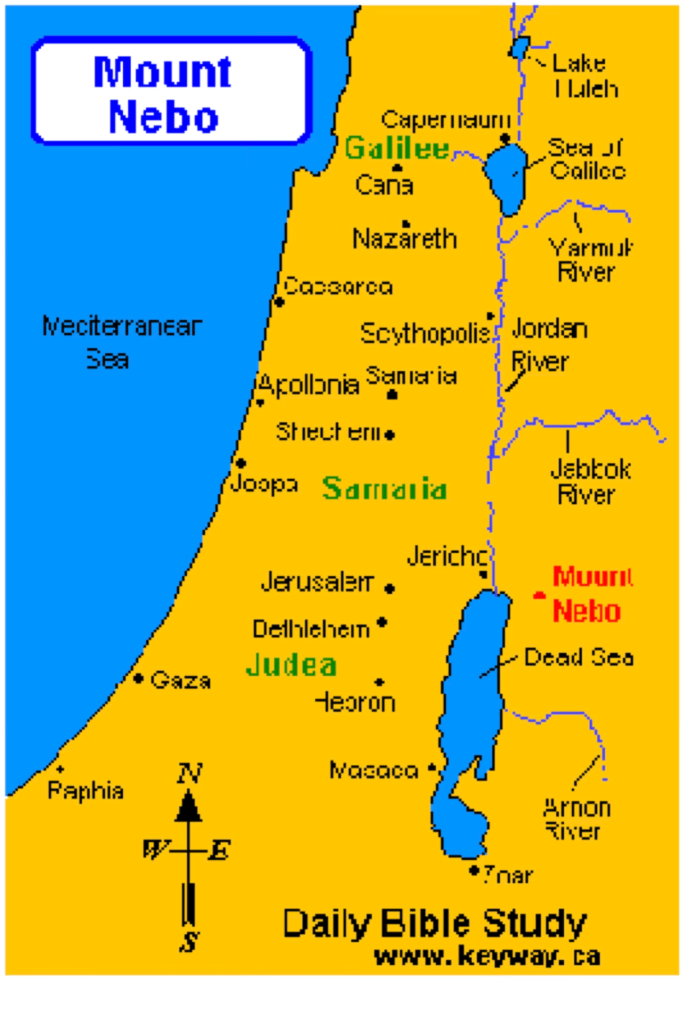
Moses is told to go up on Mt Nebo and die! 48 The Lord spoke to Moses that very same day, saying, 49 “Go up to this mountain of the Abarim, Mount Nebo, which is in the land of Moab opposite Jericho, and look at the land of Canaan, which I am giving to the sons of Israel for a possession. 50 Then die on the mountain where you ascend, and be gathered to your people, as Aaron your brother died on Mount Hor and was gathered to his people, 51 because you broke faith with Me in the midst of the sons of Israel at the waters of Meribah-kadesh, in the wilderness of Zin, because you did not treat Me as holy in the midst of the sons of Israel. 52 For you shall see the land at a distance, but you shall not go there, into the land which I am giving the sons of Israel.” Kinda sad being told “go die”. He would be able to see Canaan at a distance as Mt Nebo is just across the Jordan River from Jericho and about 3,300 feet high. From an elevation of 3,300 feet, the naked eye can see a maximum distance of approximately 70.4 miles. Mt Nebo is about 16 miles from Jericho, so Moses could see Jericho and a lot more of Canaan from Mt Nebo even if he wasn’t at the very peak. Is it sad that he won’t be able to enter Canaan? Probably so, but God is doing him a favor. Joshua will lead the Israelite armies to conquer 31 kings over the next 7 years. Is that the way the 120 year old Moses would want to end his years?
We are about to finish Deuteronomy, which might have been a struggle to read at times, but I hope you have found some valuable lessons.

