
Again, a little off the reading schedule since the last article covered all of Ruth 1-4.
Hannah’s vow and the birth of Samuel: AI
“Hannah prayed in deep anguish at the tabernacle in Shiloh, vowing to give her requested son back to God as a Nazirite for life. Eli the high priest blessed her, and she gave birth to Samuel, later bringing him to live and serve at the temple as she promised.
The Distress and the Vow
- Barrenness and Mockery: Hannah suffered deep sorrow because she had no children while her husband’s other wife, Peninnah, provoked her yearly.
- The Prayer at Shiloh: While weeping in bitterness of soul, Hannah prayed silently to God, moving her lips without a sound. [
- Eli’s Misunderstanding: Eli the priest thought she was drunk until she explained her intense grief, after which he told her to go in peace.
- The Vow: Hannah promised that if God gave her a son, she would dedicate him to the Lord all his days, with no razor ever touching his head.
Birth and Dedication
- Birth of Samuel: God remembered Hannah, and she conceived and bore a son, naming him Samuel, which means “heard of God” or “asked of the Lord”.
- Fulfilling the Promise: After weaning him, Hannah brought young Samuel to the tabernacle in Shiloh and left him in Eli’s care to minister before the Lord.
- The Aftermath: Hannah visited him every year with a small robe she made, and God blessed her with three more sons and two daughters.
Eli’s wicked sons. AI:
The priest Eli’s wicked sons were Hophni and Phinehas, who served as priests at the tabernacle in Shiloh. Described in 1 Samuel as worthless men who did not know the Lord, they abused their priestly office by stealing the best parts of the animal sacrifices and committing sexual immorality with the women serving at the tent entrance.
Sins and Corruption
- Greed and Theft: They took raw meat from sacrifices by force before the fat could be burned to God.
- Sexual Immorality: They slept with women who served at the entrance of the tabernacle.
- Disregard for God: They treated the holy offerings with contempt, causing people to resent worship.
- Eli’s Failure: Though Eli rebuked them, he failed to properly restrain or remove them from office, leading God to judge his household.
The call of Samuel. After the Lord calling Samuel 3 times, Eli told Samuel to answer “Speak, for your servant is listening.” The Lord then told Samuel that Eli’s house would be judged. 3: 12 At that time I will carry out against Eli everything I spoke against his family—from beginning to end. 13 For I told him that I would judge his family forever because of the sin he knew about; his sons blasphemed God, and he failed to restrain them.” Eli had verbally rebuked them but that is all. He should have removed them from office and maybe even carried them to the elders to be stoned to death according to the Law. To Eli’s credit, he humbly accepted his fate. 3:19 The Lord was with Samuel as he grew up, and he let none of Samuel’s words fall to the ground. 20 And all Israel from Dan to Beersheba recognized that Samuel was attested as a prophet of the Lord. 21 The Lord continued to appear at Shiloh, and there he revealed himself to Samuel through his word.” Of course, the tabernacle was at Shiloh at this time. Samuel would be the prophet who would anoint the first two kings, Saul and David. Peter credits the prophets as beginning with the prophet (and judge) Samuel: Acts 3:24 “Indeed, beginning with Samuel, all the prophets who have spoken have foretold these days.”
Judgment and Death
- Prophecy of Doom: A prophet told Eli his family would lose the priesthood and both sons would die on the same day.
- Battle at Aphek: Hophni and Phinehas died in battle when the Philistines defeated Israel and captured the Ark of the Covenant.
- Eli’s Death: Upon hearing the news that the Ark was captured and his sons were dead, the elderly Eli fell backward from his seat, broke his neck, and died. He was 98 and heavy. He had been a faithful high priest for 40 years but his 2 sons have defiled his legacy.
Who took Eli’s place as high priest? AI:
Priestly Succession After Eli
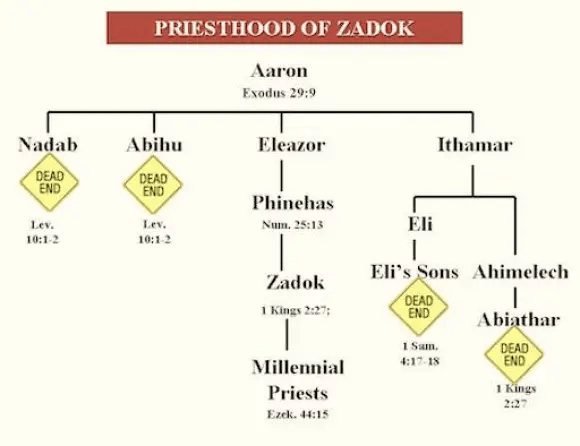
After Aaron died, the office of High Priest was passed down to his third son Phinehas, Eleazar (his two older sons, Nadab and Abihu, died earlier without children). Eleazar was succeeded by his son Phinehas (not the Phinehas son of Eli but instead the one who stopped the plague in the sin at Peor). Sometime during the period of the Judges—between Phinehas and Eli—the high priesthood moved from the family of Aaron’s son Eleazor to the family of Aaron’s youngest son, Ithamar.
- Eli served as high priest and judge from the line of Ithamar. Eli’s 2 sons, Hophni and Phinehas,were killed. Phinehas’ wife was pregnant and died giving birth to Ichabod (meaning “no glory”) after hearing that Phinehas and Eli were dead. Before she died, 4:22 She said, “The Glory has departed from Israel, for the ark of God has been captured.”
- Ahitub, Eli’s grandson, was next in the genealogical line of descent.
- Ahijah served as high priest during the early reign of King Saul.
- Ahimelech (Ahijah’s brother or son) succeeded him at Nob and was later killed by Saul.
- Abiathar was Ahimelech’s son who escaped Saul’s slaughter, later serving as joint high priest with Zadok before being exiled by King Solomon for supporting a rival claim to the throne..
- Zadok (from the line of Eleazar). Solomon replaced Abiathar with Zadok, returning the high priesthood to Eleazar’s lineage.
- The high priesthood remained with the descendants of Zadok (who was a direct descendant of Aaron’s son, Eleazar) for roughly 800 years. In total, Zadok’s line held the position for nearly 8 centuries between Zadok’s initial appointment by King Solomon (around 960 BCE) and the deposing of the last legitimate Zadokite High Priest, Onias III, in 171 BCE.”
I loved tracing the high priesthood but you might not have enjoyed that. My mom was an Old Testament scholar and could have told me verbally everything I found on AI without even looking back at her Bible (and there was no AI when she was alive).
So you might want to focus instead on how godly a mother Hannah was. She had Samuel knowing that she would give him up to be raised by Eli to serve at the tabernacle for the rest of his life. Every parent should have children with the intent of raising them to serve the Lord. Maybe not right after they are weaned, as Samuel was, but maybe even starting in their teen years serving the Lord. Mary Jones was 16 years old in 1800 AD when she walked the 26 miles barefoot across rough and rocky terrain to buy her first Welsh Bible that she had worked so hard to save money to buy. Her noble act motivated the founding of the British and Foreign Bible Society in 1804 AD. King Josiah was crowned king at just eight years old. He began seeking the Lord as a youth and initiated massive religious reforms across Israel by the time he was 16 to 26.”
You might also take note of Eli’s lack of discipline of his 2 sons. Spanking and corporal punishment declined as forms of disciplining children from the late 1900’s to today as parents increasingly adopted gentle parenting styles. Critics sometimes mislabel the absence of spanking or yelling as a complete lack of discipline which isn’t necessarily true. Others feel that parents don’t discipline their children enough regardless of their methods of discipline, spanking or no spanking. Adonijah, David’s son who tried to take the throne from Solomon as David was dying, was never told “no” as he was growing up. 1 Kings 1:6 (His father (David) had never rebuked him by asking, “Why do you behave as you do?” Absentee fathers and broken homes contributes greatly to the lack of discipline of children today.

