
1 Samuel 5-6: The ark is returned to Israel.
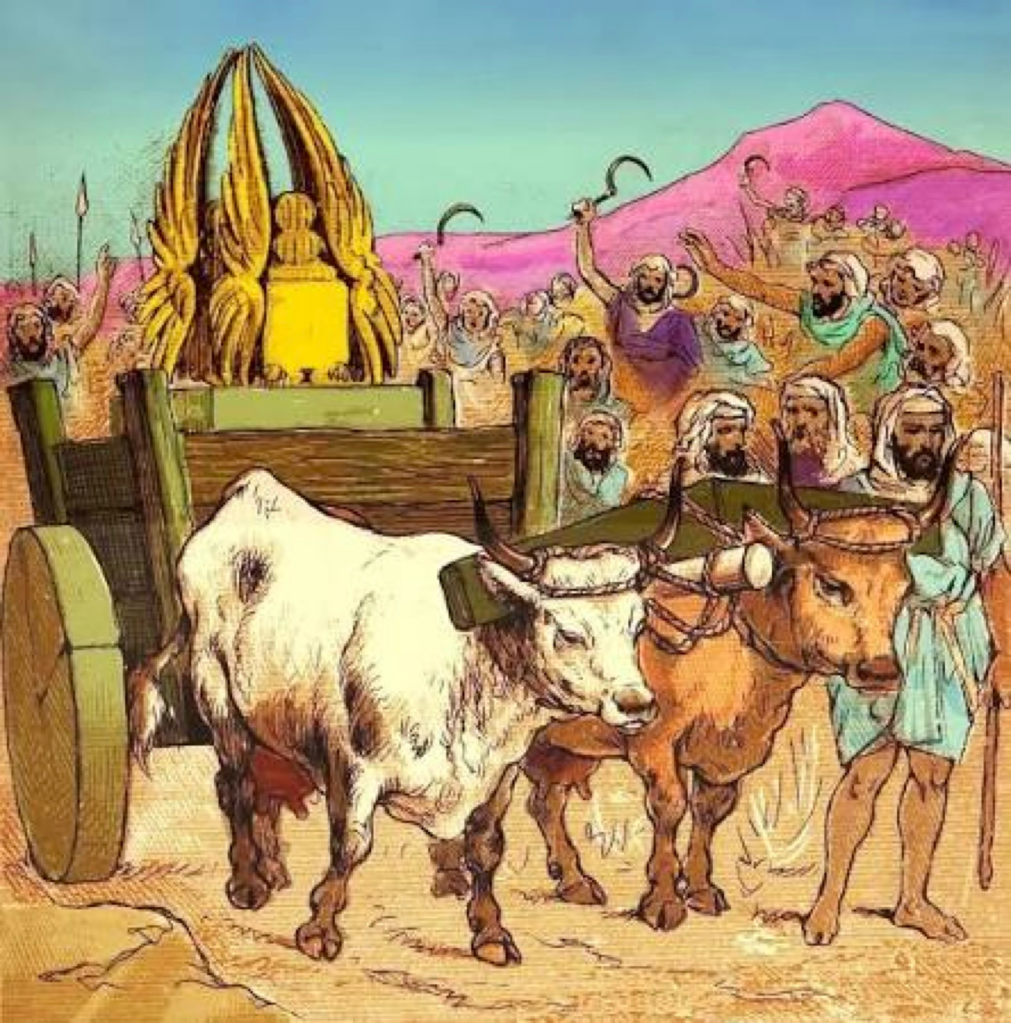
AI: Hophni and Phinehas took the ark of the covenant into battle with the Philistines and it was captured. It stayed in Philistine territory 7 months. “The Philistines returned the Ark of the Covenant to Israel on a new cart pulled by two nursing cows after suffering plagues and the falling of their idol Dagon. The cows walked straight to the Israelite border town of Beth Shemesh.
Key Scenes in the Biblical Story (AI)
- Capture and Dagon’s Fall: The Philistines took the Ark to Ashdod, but their fish-god idol Dagon repeatedly bowed and shattered before it. They moved it to Gath, and then Ashdod, but the Lord sent “tumors” in both cities.
- The Plagues: Severe outbreaks of tumors and rats struck Philistine cities, forcing their leaders to consult priests on how to send the Ark back.
- The Trespass Offering: They sent golden tumors and golden mice along with the Ark as a guilt offering.
- The Journey on the Cart: Placed on a cart with unguided nursing cows, the animals miraculously headed straight for Beth Shemesh without turning away. The 5 Philistine rulers followed, watching the cart return to israel.
- Rejoicing at Beth Shemesh: The Israelites rejoiced, harvested wheat, and offered sacrifices when the cart arrived. God killed 70 who looked in the ark.
- Taken to Kiriath Jearim: Men from Kiriaath Jearim brought the ark to that city to Abinadab’s house where it stayed 20 years. But David moved it from there to Jerusalem, which would be at least 40 years later since King Saul’s reigned 40 years. So where did the ark stay past the 20 years in 1 Samuel 7:2 until David moved it to Jerusalem? AI: “1 Samuel 7:2 states that “twenty years” passed from the time the Ark arrived in Kiriath-jearim until the house of Israel genuinely turned back to the Lord in repentance under Samuel. It is a marker for how long it took for spiritual awakening to happen, not an expiration date for when the Ark left. The Ark remained at the house of Abinadab in Kiriath-jearim for a much longer period than just the 20 years. It stayed there through the rest of Samuel’s judgeship, the entirety of Saul’s reign (40 years), and into the early years of David’s reign until David finally moved it to Jerusalem (2 Samuel 6).
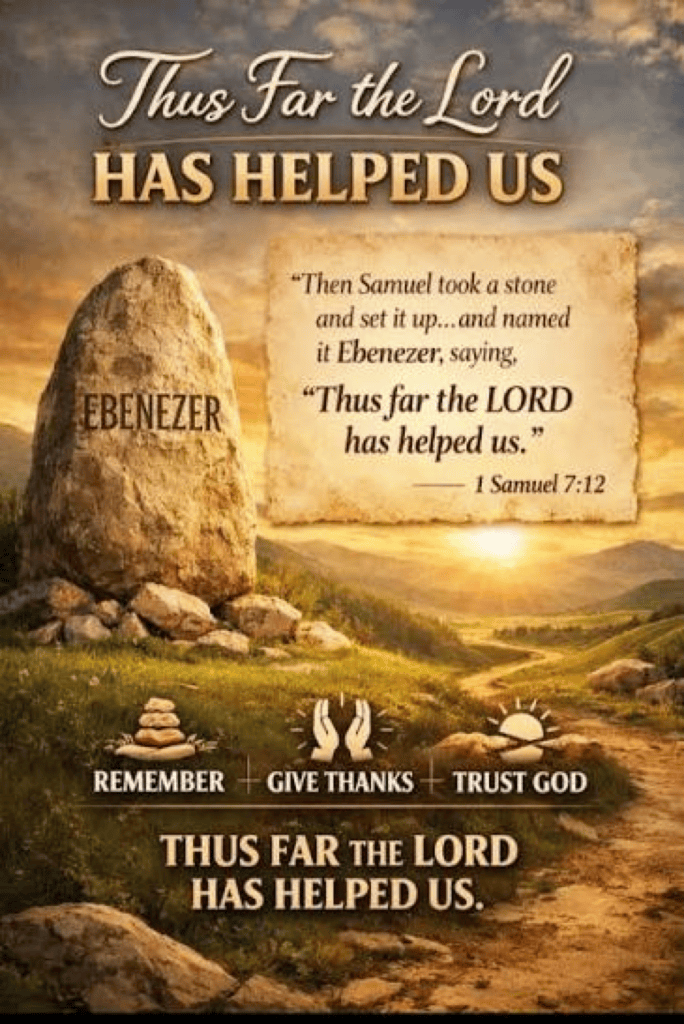
1 Samuel 7: A spiritual revival in Israel. 1 Samuel 2:Then all the people of Israel turned back to the Lord. 3 So Samuel said to all the Israelites, “If you are returning to the Lord with all your hearts, then rid yourselves of the foreign gods and the Ashtoreths and commit yourselves to the Lord and serve him only, and he will deliver you out of the hand of the Philistines.” 4 So the Israelites put away their Baals and Ashtoreths, and served the Lord only.” The Israelites assembled at Mizpah and confessed their sins. The Philistines heard that they were at Mizpah and attacked. 1 Samuel 7:But that day the Lord thundered with loud thunder against the Philistines and threw them into such a panic that they were routed before the Israelites.” The Israelites pursued them, slaughtering them. 1 Samuel 7:12 Then Samuel took a stone and set it up between Mizpah and Shen. He named it Ebenezer (which means “stone of help”), saying, “Thus far the Lord has helped us.” 13 So the Philistines were subdued and they stopped invading Israel’s territory. Throughout Samuel’s lifetime, the hand of the Lord was against the Philistines.” Samuel went on a circuit from Bethel to Mizpah to Gilgal, judging Israel, but always returned to his home town of Ramah. Estimates are that he judged Israel 20 to 40 years. A great church song: O Thou Fount of Every Blessing has Ebenezer in it. vs 2 “Here I raise my Ebenezer; hither by thy help I’m come; and I hope, by thy good pleasure, safely to arrive at home. Jesus sought me when a stranger, wandering from the fold of God; he, to rescue me from danger, interposed his precious blood.” I know most of us just sang that song and had no idea what Ebenezer, so know you know!
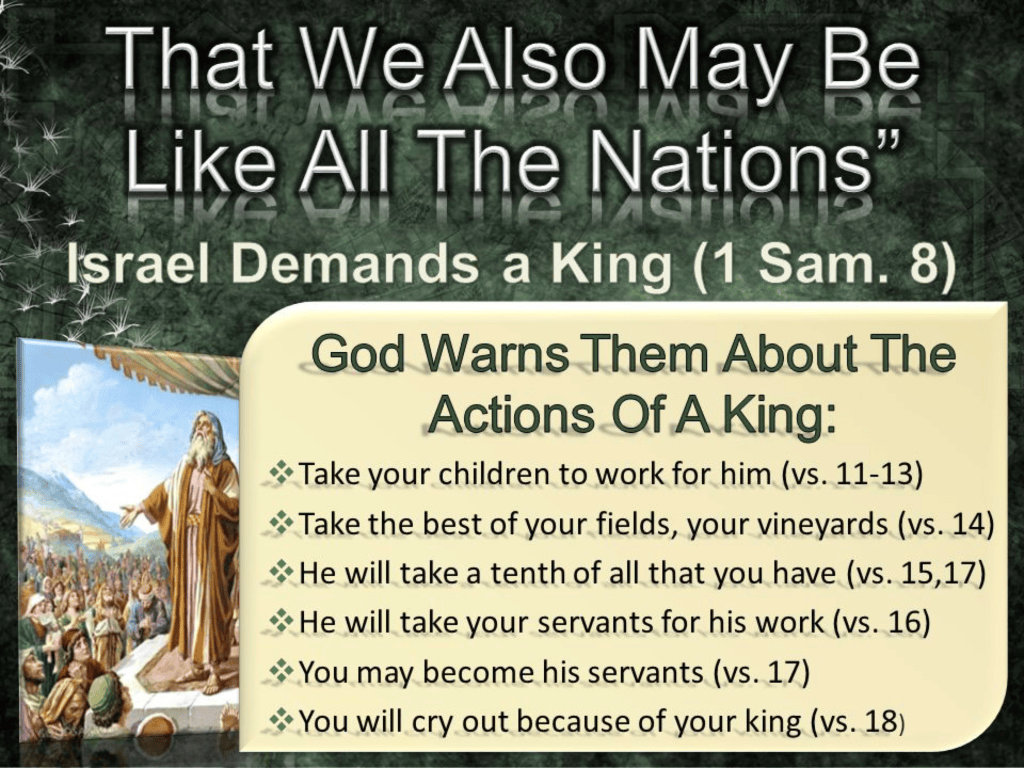
1 Samuel 8: Israel asks for a king. In his old age, Samuel appointed his 2 sons as judges but they turned aside after dishonest gain and accepted bribes and perverted justice. You would think his sons’ behavior would have really bothered Samuel since he hs experienced the trouble with Eli’s 2 sons. You would think that he would be very reluctant to appoint them as judges, but he did. That was the excuse the people used to ask Samuel to give them a king to be “like all the other nations have to lead us and to go out before us and fight our battles.” God told Samuel that they had not rejected Samuel, but had rejected God as their king. But He would give them a king anyway. Why did God give them a king if He never wanted a king and only wanted to be their king Himself? I think the main reason was to set the stage for King Jesus one thousand years later. Many years earlier Moses told the Israelites that once they would enter, take possession of, and settle in the Promised Land (Canaan), that they would eventually say, “Let us set a king over us like all the nations around us” (Deuteronomy 17:14). Moses then gave strict rules for the kings: Must be chosen by God from among their own people (not a foreigner) (v. 15). Must not accumulate many horses or send people back to Egypt to get them (v. 16). Must not take many wives (v. 17). Must not collect massive amounts of silver and gold (v. 17). Must hand-copy a personal scroll of God’s law (the Torah) and read it every day of his life to stay humble and obedient (vv. 18–20).So this had already been predicted by Moses. Wanting a king was a lack of faith and trust in Yahweh as their king to give them victory over their enemies. Samuel agrees to giving them a king but then gives this warning about the kings they will have. King Solomon pretty much violated all the rules for the kings which led to the split of the united kingdom.
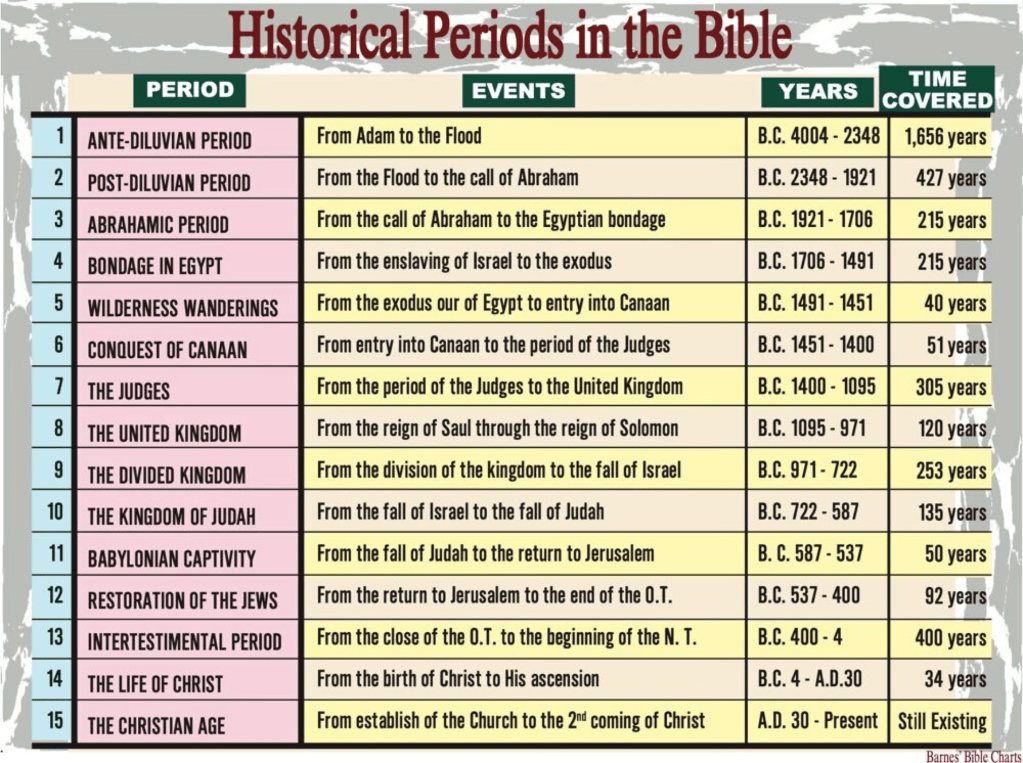
1 Samuel 9: Samuel meets and eats with Samuel, getting ready to anoint him as the first king of Israel. This begins the period of the “United Kingdom”. At first, Saul seems like a wise choice. He was “as handsome a young man as could be found anywhere in Israel, and he was a head taller than anyone else.” At first he seemed to be humble. When Samuel told him, “And to whom is all the desire of Israel turned, if not to you and your whole family line?” Saul replied “But am I not a Benjamite, from the smallest tribe of Israel, and is not my clan the least of all the clans of the tribe of Benjamin? Why do you say such a thing to me?” Unfortunately Saul’s true colors would come out as we continue the reading next time.
This might be a little opinionated, but here we go. God set up Israel as His theocracy with Him as the king, but Israel wanted to do it their way. They wanted a king to fight their battles for them instead of trusting God for their victories. God set up the church as house churches with elders to shepherd the sheep and deacons to serve physical needs of the sheep. Yes they had apostles and prophets but those gifts ceased after the first century. They had evangelists who traveled to churches but did not stay to become “located paid preachers”. Paul told the churches to provide for the needs of the traveling evangelists but the 1st century document the Didache said that if they stayed more than 2 or 3 days that they were just preaching for money. That was the simple structure of the churches that Jesus established. But by the 2nd and 3rd century, the church started adding positions of authority. AI has a summary: The Threefold Order: By the mid-to-late second century, the structure unified into a distinct three-tier office: bishops (monarchial overseers), presbyters (priests/elders), and deacons. Rise of the Single Bishop: Influential figures like Ignatius of Antioch advocated for a single bishop per city (monepiscopacy) around 110 AD to maintain unity and guard against emerging heresies like Gnosticism. Apostolic Succession: To validate teaching and authority, writers like Irenaeus and Tertullian emphasized apostolic succession, tracing unbroken lines of bishops back to the original apostles commissioned by Jesus. Centralization of Rome: Over the 2nd and 3rd centuries, the pre-eminence of specific historical sees grew, eventually setting the stage for the Bishop of Rome (the Pope) as a supreme authority in Western Christianity.” Thus evolved the Papacy of the Roman Catholic Church and we all know the corruption and oppression that caused for the next thousand years of Catholicism. The Reformation Movement rejected the papacy but still ended up divided by followers of men like Martin Luther (Lutherans), John Calvin (Refeormed churches), Zwingli, John Knox (Presbyterians), John Huss (Moravians and The Brethren), King Henry VIII (Anglicans), Menno Simmons (Anabaptists, Mennonites, Almish), John Smyth (Baptists) , John and Charles Wesley (Methodists), Charles Parham (Pentecostalism), Joseph Smith (Mormons), Ellen G White (7th Day Adventists), Mary Baker Eddy (Christian Science), Charles Russell (Jehovah’s Witnesses), Alexander Campbell and Barton Stone (Churches of Christ), etc. Each leader and church that evolved from that leader had its own creed instead of just using the Bible. Do you think this is what Jesus wanted his church to look like? Many of these leaders taught basic Christian truths but others were dangerous cults led by cult leaders. The problem is that Christians started following “men who would be kings”. The Bible is fully sufficient for Christians just to gather in house churches and continue in “the apostles’ doctrine fellowship, breaking of bread (including the Lord’s Supper) and prayer” without these leaders and creeds. In addition we now have the LGBTQ advocate churches with well paid men in authority (as kings) leading the flock into error. Even among the conservative churches, the church has evolved into a “business”. They pay a lot of money to find a pastor or preacher who will help their church grow and that man (or woman) becomes the king. They hire many other positions of leadership instead of using elders and deacons to lead in the work of the church. They compete for the best preachers that people will come to hear. They provide the best musicians and singers for church assemblies to compete with the other bands. They spend on average about 80% of the money they collect on buildings and staff. Have we made us a king so we can be like the other churches? Have we forsaken letting God organize the church the way Jesus wanted it in order to make it how we want it? Have we made the same mistake that Israel did in wanting a king? I think we have. What do you think?

