
Chapter 11: Clean and unclean meat. Great slide. Barnes Bible Charts has a lot of great images you can research.
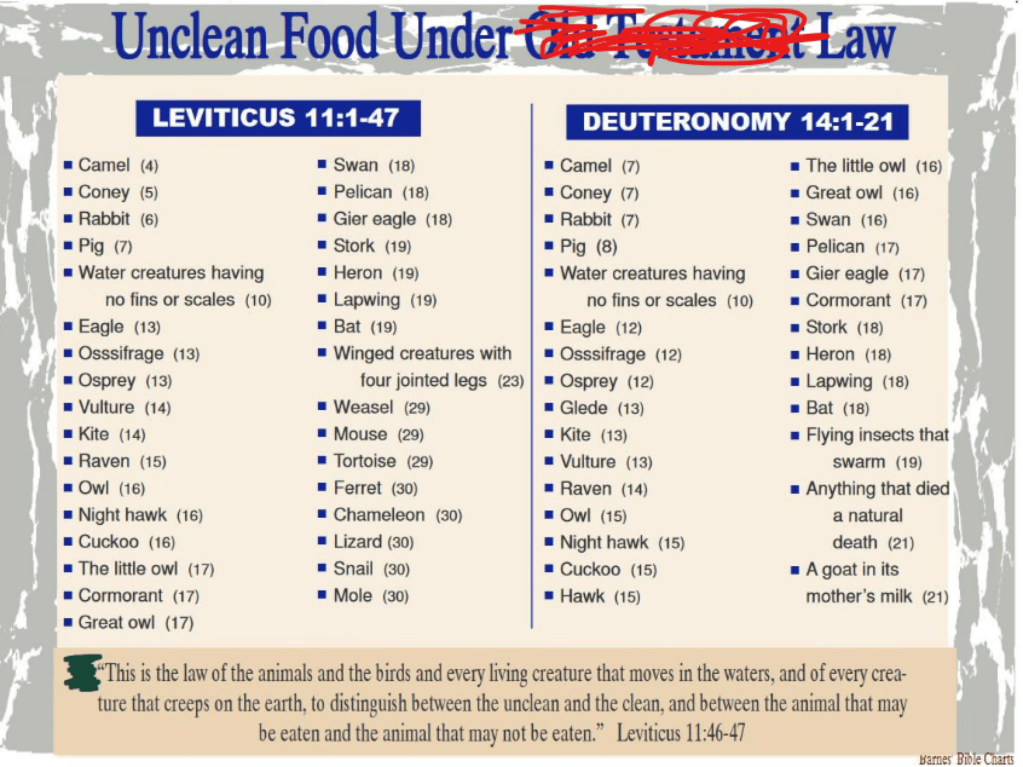
Why did God forbid eating of unclean meats? That avoided eating scavengers that carried harmful diseases (although rabbits aren’t scavengers, and spanish mackerel, and swordfish don’t have scales and aren’t scavengers but are unclean). I’m not sure what other reasons God might have commanded this. What about Christians eating unclean meats today? Groups like the 7th Day Adventists won’t eat pork. These food laws were given specifically to Israel and not to Gentiles or all mankind. Paul answered this question in 1 Timothy 4:1 But the Spirit explicitly says that in later times some will [a]fall away from the faith, paying attention to deceitful spirits and doctrines of demons, 2 by means of the hypocrisy of liars seared in their own conscience as with a branding iron, 3 men who forbid marriage and advocate abstaining from foods which God has created to be gratefully shared in by those who believe and know the truth. 4 For everything created by God is good, and nothing is to be rejected if it is received with gratitude; 5 for it is sanctified by means of the word of God and prayer.” Christians are under the new covenant, not the old, and can eat anything as long as they give thanks.
Chapter 12: Laws of motherhood.
A “sin” offering after childbirth. AI: “In ancient Israelite law, contact with major bodily fluids and blood made a person ritually unclean for a set time (40 days for a boy, 80 days for a girl). The Hebrew word for “sin offering” (chata’at) is often better translated as a “purification offering.” It restored the mother so she could re-enter the holy sanctuary. The sacrifice did not mean the mother committed a personal crime or moral wrong. It simply removed the ritual barrier caused by the blood of childbirth.” Luke 2:22 “And when the time came for their purification according to the Law of Moses, they brought Him (the baby Jesus) to Jerusalem to present Him to the Lord.”
Chapter 13: The test for leprosy.
AI: The word for “leprosy” צָרַעַת (tsaraath) designates an array of divinely diagnosed contaminations that could afflict skin, clothing, and even houses. It likely included common issues like psoriasis, eczema, boils, ringworm, and lucoderma. Scripture never confines the term to modern Hansen’s disease; instead, it functions as a covenant marker of uncleanness that calls for priestly discernment and ritual resolution. The word appears about thirty-five times, with its densest concentration in Leviticus 13–14.” Of course it included Hansen’s Disease. White hair in the infection is mentioned as a test for leprosy. tzaraath actually described a broad category of escaling or inflammatory skin conditions. It most likely referred to vitiligo, an autoimmune condition where skin completely loses its pigment and the hairs inside the white patches frequently turn white. As you can see, the priests are the health officers, not doctors. Some of the skin diseases were contagious and the laws of leprosy helped keep them from spreading. God was concerned about the physical and spiritual welfare of Israel (and us also).
Chapter 14: Cleansing a leper or a leprous house.
Under the Law of Moses outlined in Leviticus 14, cleansing a healed person with a skin disease required a careful, multi-day purification ritual conducted by a priest which included several animal sacrifices. It is interesting that the priest offered a guilt offering and placed blood on the tip of the person’s right ear, right thumb, and right big toe. It is also interesting that leprosy could be found in houses, resulting even possibly in tearing down the whole house.
Chapter 15: Laws for bodily fluids and discharges
Leviticus 15 outlines ancient Israelite laws regarding ceremonial uncleanness caused by various bodily fluids and discharges. These laws included bodily discharges of sexually transmitted diseases, normal seman emission, a woman’s menstrual periods, and prolonged or abnormal bleeding outside of the normal menstrual cycle. The woman with the blood issue that Jesus healed would fit into that last category.
Many of these laws were just for ceremonial uncleanness and did not involve moral sins. Many of them were just designed to prevent the spread of disease and for good hygiene. Remember, these laws were given when the priests were serving as the health officers and there were no doctors. Doctors today could use these same methods to detect diseases today, I suppose.
Hang in there! Halfway through your favorite book in the Bible.

